Understanding endophyte alkaloids
Ryegrass endophytes produce different alkaloids (or chemicals). Use this tech sheet to help you decide which is right for your farm system.
Ryegrass endophytes produce different alkaloids (or chemicals)
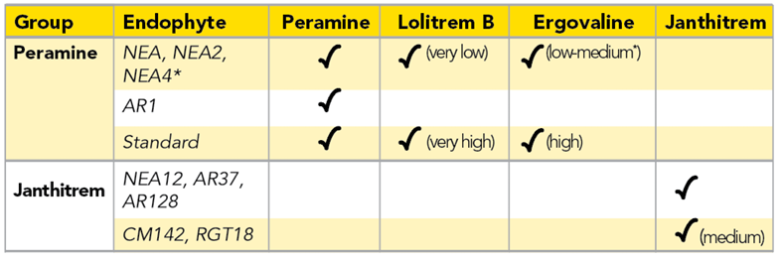
Peramine
Peramine is an alkaloid produced by some ryegrass endophytes. It provides good control of the pasture pests Argentine stem weevil and pasture mealy bug. It is not known to have any adverse effect on animals.
Lolitrem B
Lolitrem B is the alkaloid produced by some ryegrass endophytes. At high levels this alkaloid can cause ryegrass staggers or summer staggers in animals.
Animals grazing ryegrass with Standard endophyte (SE) are most likely to suffer staggers. Little seed with SE is sown nowadays, it is mainly found in old pastures. The worst staggers occurs when animals are pushed to graze into the base of plants in dry summers, or grazing the first pick of green growth following a dry spell. This is because lolitrem B is concentrated in the base of the plant (see graph).
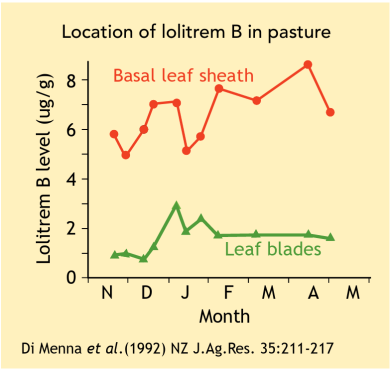
Lolitrem B is also found in seed heads (see Endophyte FAQ’s), so grazing rank seedy pasture can also cause problems.
Staggers present as tremoring in mild cases and staggering in more severe cases. Animals rarely die directly from staggers, but may die through misadventure, such as drowning in streams.
Staggers causes severe management problems if stock must be regularly handled, e.g. milking cows. A low level of staggers usually clears up within 1-2 days if animals are fed a diet free from lolitrem B. Severe staggers can affect animals for weeks.
Lolitrem B is very stable in hay or silage so be careful buying or feeding these if they are made from Standard endophyte ryegrass pasture.
Barenbrug endophytes produce very low levels of lolitrem B, so provide staggers free pasture for dairy cows and beef cattle. On sheep or deer farms, while ryegrass staggers are very unlikely to occur, in dry summers if animals are forced to graze plant stems and crowns close to the ground (which should not happen from an animal performance or welfare perspective) a low level of staggers may be seen.
Ergovaline
Ergovaline helps protect plants against insects, including black beetle and root aphid, but high levels of ergovaline (e.g. from Standard endophyte) can sometimes reduce animal performance. Some Barenbrug endophytes produce moderate levels of ergovaline (for enhanced insect protection). Testing has shown these levels are unlikely to affect animal health and performance under good grazing management.
The distribution of ergovaline through the plant differs for different endophytes, but it is usually concentrated in the crown (base) of the plant. This is an important benefit as leaves are your animals’ main diet, whereas the crown contains the growing points, and needs protection from insect damage. Seeds can also contain high ergovaline levels which is why grazing rank seedy pastures can be a problem. Ergovaline increases in summer with rising temperature and seed head development, and in response to moisture stress. To minimise animal health issues, keep pastures leafy through late spring, and try not to graze close to the ground in summer. Use other feeds (e.g. summer crops, silage, PKE, grain) to dilute alkaloid intake and greatly reduce the risk of any endophyte issues.
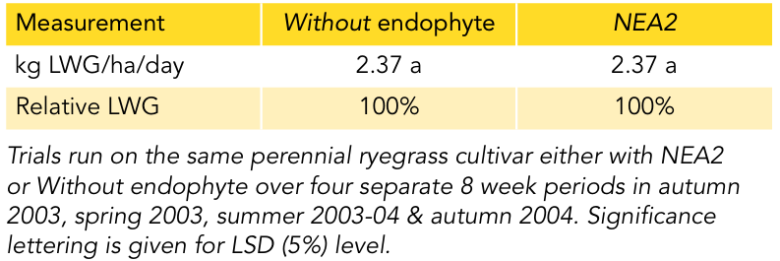
Animal health trials on NEA2 endophyte in diploid ryegrass have shown the same lamb growth as those on the same ryegrass Without endophyte
Lamb liveweight gain (LWG) in Lincoln University trials
Trials suggest the ergovaline eaten by dairy cows grazing well managed NEA2-based ryegrass pastures is unlikely to affect animal production. A review of animal intake research¹ showed ergovaline intakes below 0.03 mg/kg LW0.75/day have never shown any effect on animal performance, with diploid NEA2 pastures testing at below this safe level (see graph).
¹ Nicol & Klotz. 2016. Animal Production Science 56:1775-1786
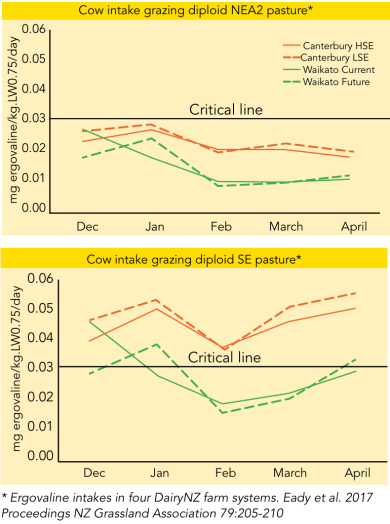
Calculated ergovaline intakes of cows grazing Standard endophyte were almost double those of NEA2.
Janthitrems
Janthitrems are alkaloids produced by NEA12, AR37, AR128, CM142 and RGT18 endophytes. These endophytes produce no peramine, lolitrem B or ergovaline.
Janthitrem levels follow the seasonal pattern of other alkaloids, i.e. low in winter and high in late summer and autumn, and give a wide spectrum of insect resistance (see endophyte insect control ratings).
High levels of janthitrems can cause staggers, although this is not as severe as that caused by Standard endophyte (see endophyte animal control ratings). In lamb LWG trials testing commercial janthitrem-producing endophytes, some ryegrass staggers is seen in sheep typically in dry summers where animals are pushed to eat into the base of pasture. This can be severe, and will impact animal health and growth.
Like lolitrem B, a low level of staggers usually clears up within 1-2 days if animals are fed a diet free from janthitrems. Severe staggers can affect animals for weeks.
In endophyte trials run by DairyNZ no ryegrass staggers have been seen in dairy cows grazing a commercial janthitrem-containing pasture.