Endophyte FAQs
What are endophytes? This section answers this, along with the most frequently asked questions.
What are endophytes?
Endophytes are fungi which have evolved to live in harmony with ryegrass. They live inside the seed and plant, and produce natural compounds (or alkaloids) which protect plants from pests.
Why use them?
Endophytes can enhance ryegrass yield and persistence by helping protect plants from a range of insects and other pests. In summer dry pastures, ryegrass with certain endophytes can out perform ryegrass Without endophyte.
Why do you need to know about them?
Different strains of endophyte are available so it’s important to know which is best for your situation, but remember the ryegrass is the principle feedstock for your animals. The right endophyte should complement your ryegrass choice.
Standard endophyte (SE) was the initial endophyte studied, it can depress animal performance and cause summer ryegrass staggers. Subsequent endophyte discoveries identified less toxic versions e.g. AR1, NEA, NEA2 and NEA4, NEA12, AR1, AR37, AR128, CM142 and RAGT18. These commercially available endophytes have varying levels of insect control but still some toxicity to livestock (usually below any clinical threshold level unless pasture is poorly managed).
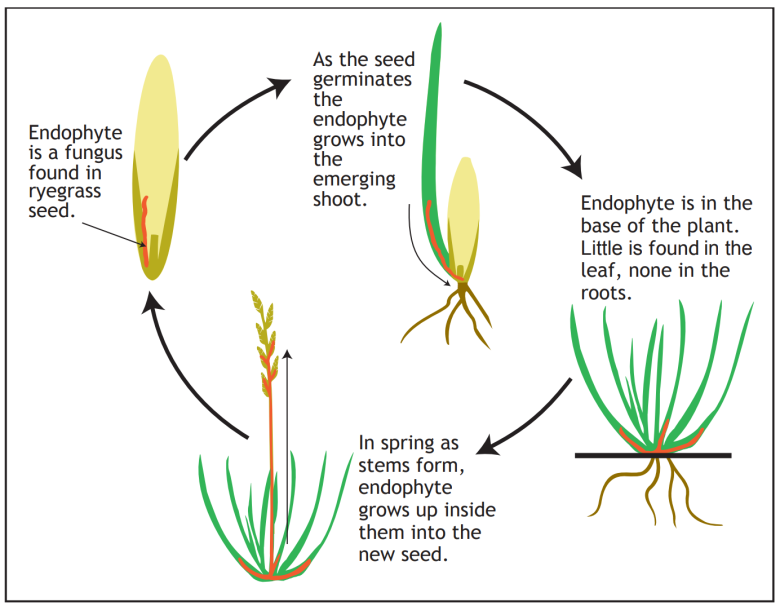
What’s its life cycle?
When you sow ryegrass seed containing an endophyte strain, resultant plants will always contain that endophyte. It stays inside the grass for the life of that plant. If you sow seed Without endophyte, those plants will never have endophyte. It does not transfer from plant to plant, or from soil to plant; it only transfers naturally from plant to seed.