
Test the waters
Diving into a new perspective
For nearly a century, one metric has quietly underpinned almost every feed decision on farm – what to grow, when to graze (or not), how many animals to buy, sell or keep.
It has been useful.
It has also been incomplete.
The number used most for pasture tells us nothing about its principal component.
What if we’ve been focusing on the wrong thing?
Out of sight, out of mind
The term ‘dry matter’ first appeared in New Zealand pasture research in the 1930s.
Other metrics have emerged since – crude protein, digestibility, water soluble carbohydrates, metabolisable energy, neutral detergent fibre.
But pasture is mostly water! So much so, animals often eat all the water they need, rather than drink it.
This invisible, grazeable water is rarely measured or valued. Quite the opposite, usually. (When’s the last time you got excited about ‘watery’ pasture?)
The closer we track nitrogen through New Zealand livestock systems, however, the more relevant grazeable water becomes, especially for nitrate leaching.
Cut and dried?
Increase the water intake of any animal (including humans), and you know what happens.
Urine volume rises; urine concentration falls. That’s why dilution has become pivotal in developing strategies to reduce farm nitrate leaching, particularly from dairy farms.
It’s also why there’s no one simple solution. In fact, limiting strategies to a single species or tool shuts the door to other candidates – several of which are already familiar, reliable and easy to manage.
Study the nitrate challenge from a grazeable water perspective, and pasture as a whole, rather than any one forage species, presents promising opportunity.
Multiple choice
On a scale of one to 10, one being the lowest and 10 the highest, which common pasture plants contain the most water?
The answer may surprise you. Chicory tops the list, followed by plantain, clover, then ryegrass.
However, ryegrasses differ substantially, with tetraploids containing more water than diploids, and annuals more than hybrids or perennials. At the bottom of the list is diploid perennial ryegrass.
Now cross-reference those relative grazeable water rankings with other attributes you demand of a successful pasture – persistence, yield, palatability, feed value, seasonal growth and ease of management.
Then bring in water-use efficiency. Different species perform best at different levels of soil moisture. If your farm is rainfed, that limits yield and drought resilience. If you irrigate, it affects your electricity bill. Not every high-water plant is equally efficient with the water it uses.
Balancing act
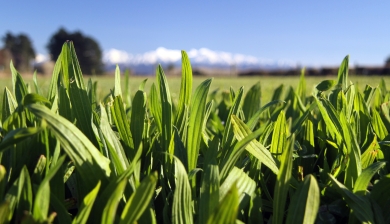
Here’s a rough example of all these factors at play. Chicory combines high grazeable water, high metabolisable energy and reliable dry matter yield. But it doesn’t last long, and it’s winter dormant.
That’s three ticks (urine dilution, nutrition and productivity) and two crosses (persistence, seasonal growth). Because it’s mostly used as a summer crop, there’s also not a huge amount grown, so its influence on our industry is limited by scale.
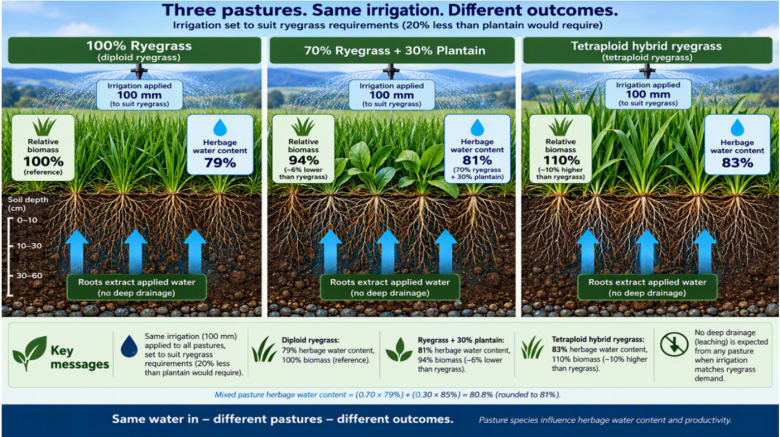
Tetraploid ryegrasses have less grazeable water than chicory, but more than diploid ryegrass. They have high metabolisable energy, good yield, provide shoulder-season feed and persist well under good management.
That’s three-quarters of a tick for urine dilution, and four ticks for nutrition, productivity, seasonal growth and persistence. Plus tetraploids scale. Thousands of hectares are already under grazing nationwide.
Plantain sits high on the water ranking and has helped put dilution on the map. It can be useful. It also brings its own management realities – persistence among them – and it is not the only way to get more water into the cow.
Fit for purpose
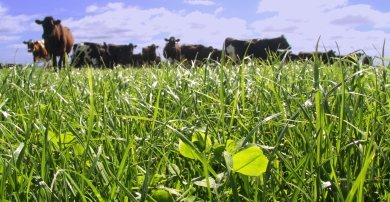
What’s shaping up here is a flexible, adaptable matrix of potential nitrogen mitigation options.
That matrix only appears when you have more than one species, and more than one attribute, to work with.
Yes, it seems complex. But managing excess nitrogen in New Zealand grass-fed systems is a multi-dimensional challenge influenced by many variables, including how much water the pasture itself is delivering.
Any mitigation strategy that doesn’t account for these variables is almost worse than none at all, because it discourages us from looking for others, and from making them work too.
If history has proved one thing in New Zealand farming, it’s this: the more ways you have to tackle a challenge, the better your outcome.
The last word
Amid this debate, and others about future farm systems, certain fundamentals always prevail.
Efficient farms are better than inefficient farms for the environment, animals and those whose livelihoods depend on them.
Healthy, well-managed, well-grazed pasture – made up of plants that suit your conditions and nourish your animals – is inherently less wasteful and more efficient than pasture which does not fit your system.
And we are always here to help! Book your free personal Pasture Health Check today.

Book a free pasture health check
Click here to request a free on farm pasture health check with one of our local experts.