
Brassica diseases
This section lists a range of diseases, to help you identify them and their importance. Good planning and crop rotation reduce the risk of disease. Monitor growing crops so you can take appropriate action early.
First, minimise your risk
Good planning and crop rotation reduce the risk of disease. Always monitor growing crops for signs of trouble and take appropriate action early.
This chapter will help you identify a disease and its importance.
Rotate crops
After brassicas are grazed, remaining residue (stubble, root and dead leaf) creates an ideal environment for disease build up. These pathogens are often soil- borne, and are waiting to infect their next host.
Rotating crop paddocks through pasture is the best way to break this disease cycle.
How long that break needs to be depends on the disease (e.g. Sclerotinia can persist in soil for 4 years), and the tolerance level of the following crop (e.g. kale is more disease tolerant than swedes).
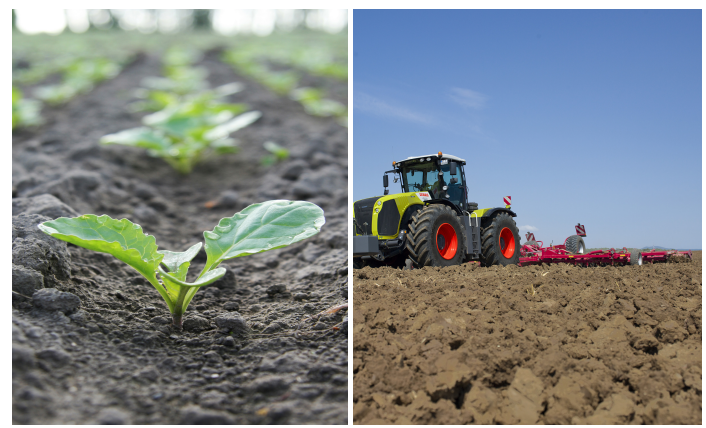
Use treated seed. Bury crop trash well.
Cultivate well
After the crop is finished, plough all trash into the ground. Work early and well to get the best breakdown and burial of crop residue before resowing.
Keep crops healthy
A healthy crop can better withstand disease. For example good leaf growth will compensate for minor leaf damage.
Use treated seed
Good seed treatments (e.g. Agricote Brassica) provide seedlings with fungicides to limit the risk of diseases such as Fusarium and Pythium. They also contain insecticide, reducing insect tissue damage, which can be an entry point for disease to infect plants.
Alternaria leaf spot (ALS)
Two Alternaria fungi, A. brassicae and A. brassicicola, cause these leaf spots on most brassica species.
Identification
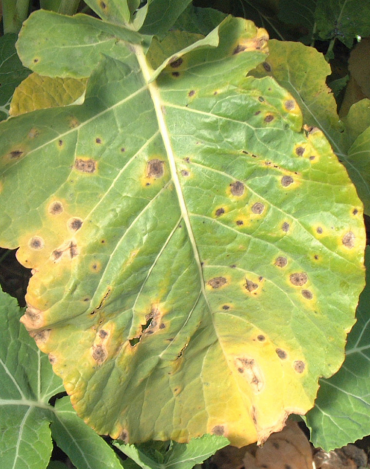
A. brassicae causes light brown circular spots with large yellow margins on leaves in autumn and early winter, A. brassicicola causes dark circular spots with narrower yellow margins on leaves in summer.
Importance
ALS reduces leaf photosynthesis, reducing crop yield, and feed quality.
Spread
ALS spreads via water splashed or wind-borne spores produced by lesions on crop residue or weeds. Wet, humid weather favours spore production. Infected seed can also be a source of disease.
Prevention and management
Sow clean seed to minimise infection, and cultivate well to work in all brassica crop residue. Graze early if forage becomes infected to contain the spread of the disease. There is no risk to animals grazing infected brassicas.
Bacterial leaf spot and black rot
Two common bacterial leaf diseases in brassicas are bacterial leaf spot (Pseudomonas syringae pv. maculicola) and black rot (Xanthomonas campestris pv. campestris). Both affect a range of brassica crops. Pseudomonas syringae is primarily a leaf pathogen whereas Xanthomonas campestris systemically infects the plant.
Identification
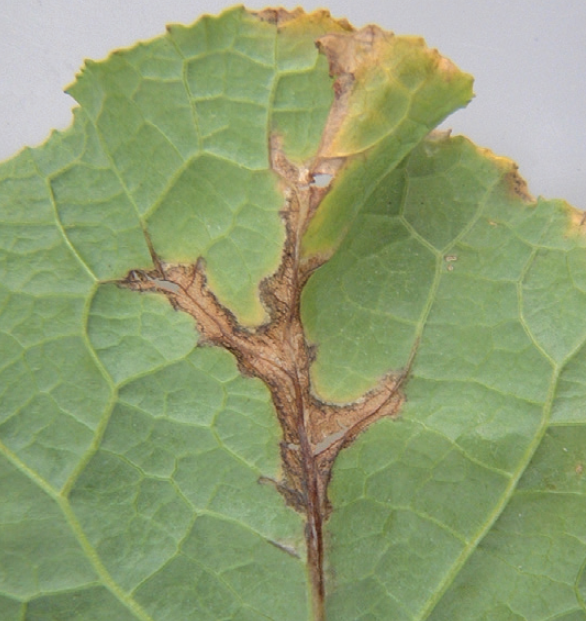
Pseudomonas syringae pv. maculicola is typically seen as light brown- black spots with narrow to wide yellow halos. Xanthomonas campestris pv. campestris causes V-shaped lesions on the leaf edge where the veins turn black. Black internal stem staining also occurs. Infected leaves become yellow and die prematurely.
Importance
Damage to leaves can be severe and reduce feed quality and yield.
Spread
Both these bacterial pathogens can survive on crop debris in the soil and can be seed-borne. Pseudomonas syringae pv. maculicola can also survive on weeds. Warm, wet, windy conditions help disperse spores, which enter the host tissue through wounds or natural openings.
Prevention and management
Sow machine cleaned and certified seed to minimise infection, and allow at least a three-year rotation following an outbreak using non-host crops like ryegrass.
Bacterial soft rot (BSR)
BSR causes secondary damage following infection by other pathogens (e.g. dry rot) or through tissue damaged by insects or weather. It is caused by the bacteria Pectobacterium carotovorum and Pseudomonas marginalis pv. marginalis.
Identification
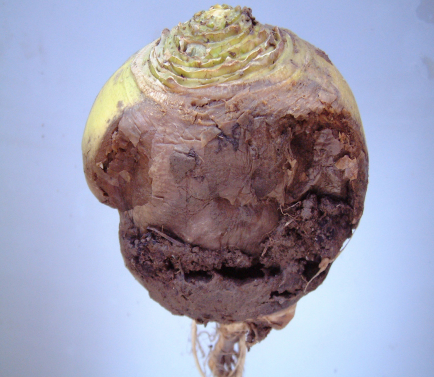
BSR produces a soft, watery light brown-grey rot often with an unpleasant odour. Although similar to Sclerotinia infection, no white mycelium is associated with the damage and no sclerotia are produced.
Importance
In favourable conditions, BSR can cause considerable damage on top of the original infection or damaging agent.
Spread
BSR is mostly soil-borne and enters the host through rain splash from wet soil onto damaged areas. It then spreads by direct plant contact, animal/machinery movement and by insects.
Prevention & management
Minimise plant damage and carry-over of host debris to reduce the risk of BSR. Good crop rotation and cultivation practices are essential to limit damage caused by this disease.
Club root (CR)
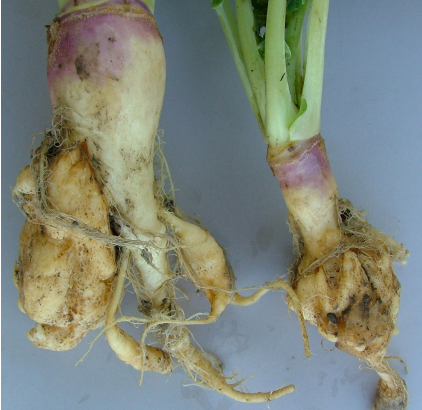
CR, caused by the fungus Plasmodiophora brassicae, can affect most brassicas, causing galls to form on roots and reducing yield.
Identification
Symptoms include plants wilting in the heat of day and recovering in the evening. On inspection of roots, infected plants have swollen galls ranging from a few cm in diameter to the size of a clenched fist. As CR progresses, lower leaves turn yellow and droop permanently, the plant may die, and yield is severely affected.
Importance
CR is the most destructive disease of brassicas and severe outbreaks can completely destroy crops.
Spread
CR can remain dormant in the soil for many years as spores. In the presence of susceptible hosts. (other Brassicaceae), these spores germinate, infecting the host through root hairs or wounds. Common host weeds are wild turnip, shepherd’s purse or hedge mustard.
Prevention & management
Minimise CR with good crop rotations and avoid multi- cropping the same species. Good weed control, good drainage and liming to increase soil pH also limit the development of CR. If CR is a likely issue, choose a cultivar with known CR tolerance.
Damping off (DO)
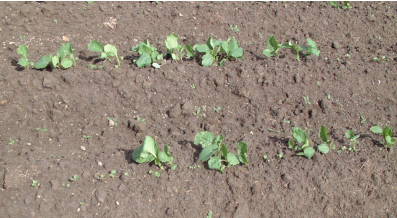
Seedling brassicas can be attacked by DO pathogens, which cover a range of fungi that cause death and gaps in establishing crops.
Causal pathogens are Pythium, Fusarium spp. and Rhizoctonia solani. Early infections are known as damping off, while those of R. solani occurring later are known as wire stem. Agricote Brassica provides early control of DO.
Identification
Young plants wilt and die from lesions at and below soil level. Infections of R. solani at later growth stages result in young plants turning purple and surviving only by the vascular strands (or wire stem), eventually dying.
Importance
Infection is common in second year brassica crops where gaps in establishment occur.
Spread
All the fungi are soil-borne and spores, mycelium or sclerotia can build up over successive susceptible crops in the same ground. Wet, cold conditions encourage infection.
Prevention & management
Seed treatment with fungicides, such as Agricote Brassica, provides early control of damping off. Long rotations between brassica crops will also reduce risk of infection.
Downy mildrew (DM)
DM is caused by the fungus Hyaloperonospora parasitica, which infects seedlings, leaves, flowering stems and seed pods.
Identification
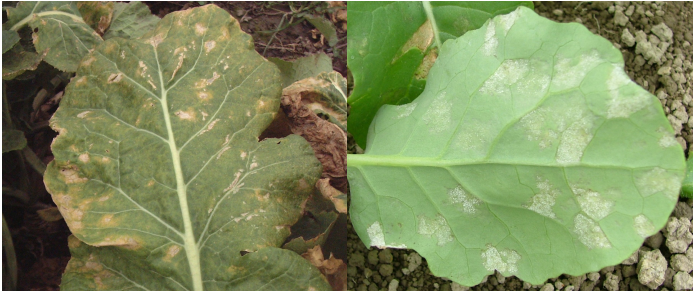
DM symptoms on kale leaf. Early symptoms of DM on underside of swede leaf.
On seedlings, DM can infect cotyledons and show up as black dots, yellowing and reddening, with purplish grey sporulation on the cotyledon underside. Young leaves can show similar symptoms. On older leaves, DM appears as lesions with leaf yellowing, often accompanied by black speckling. Affected leaves die off prematurely.
Importance
DM can greatly affect feed quality and yield.
Spread
DM can remain in the soil as free-living oospores or in trash. In spring, these spores infect leaves, building up rapidly in mild, moist weather. DM may also be introduced via seed.
Prevention & management
Sow machine cleaned and certified seed to minimise infection, cultivate well and control weeds. Good crop rotations are a must, especially in areas with high levels of DM present. If infection does occur, grazing affected plants limits spread of the disease within the crop.
Dry rot (DR)
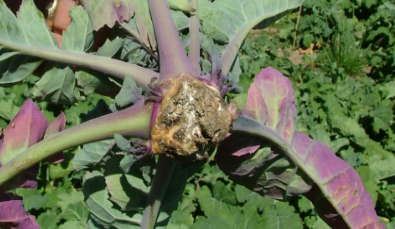
DR, also known as black leg, is caused by the closely related fungi Plenodomus lingam and P. biglobosa. It can be highly destructive in swede, rape and kale, and occurs throughout NZ, most commonly in the lower South Island.
Identification
DR appears as small brown lesions on leaves in summer and autumn. On stems and bulbs, DR develops into large brown-black dry and cracked lesions. On stems, black streaking can develop on the surface tissue. In wet weather, lesions ooze a rose-pink spore mass.
Infected leaves die, bulbs collapse, and stems break at the lesion.
Importance
DR can be very destructive, causing high crop losses in some instances.
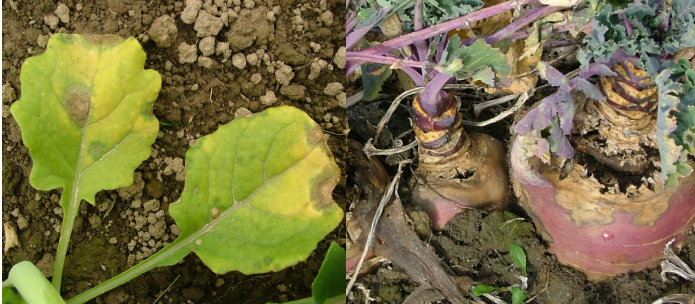
DR symptoms on leaf of young swede plant. Advanced DR on swedes.
Spread
DR over-winters in infected crop residue, and spores can spread up to 1-2 km after rain. DR enters bulbs and stems through growth cracks or insect feeding wounds. Although not common, infected seed can introduce DR into new areas.
Prevention & management
Use cultivars with higher DR tolerance in problem areas, and sow only treated, certified seed. Good crop rotations are essential, with at least a three year break before resowing a brassica species. Where DR was noted in a first crop, do not follow with the same crop in the second year. Cultivate thoroughly to ensure full breakdown of crop debris before resowing.
Powdery mildew (PM)
PM is caused by the fungus Erysiphe cruciferarum and is a common minor disease of brassicas, mostly in late summer and autumn
Identification
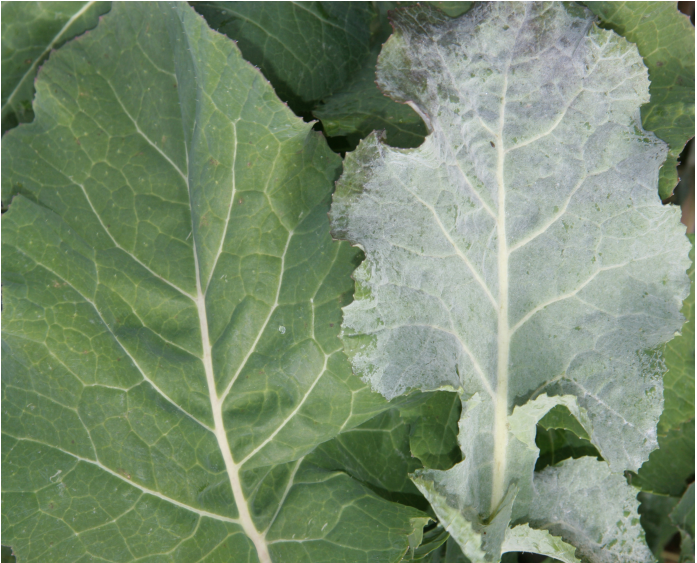
Powdery fungal growth occurs on upper and lower leaf surfaces. Leaves can become yellow and drop prematurely.
Importance
Sometimes causes damage in summer sown forage crops going into winter.
Spread
PM survives winter as a fungus on infected plants, weeds or crop debris. Air-borne spores produced in spring can land on susceptible plants, causing new infections. Spores are also released after rain in autumn.
Prevention & management
Normally, no control is required. The best prevention is to use PM resistant cultivars. Good cultivation and crop rotations ensure low levels of crop debris and weeds for PM to survive on.
Ring spot (RS)
RS, caused by the fungus Neopseudo cercosporella brassicae, occurs sporadically.
Identification
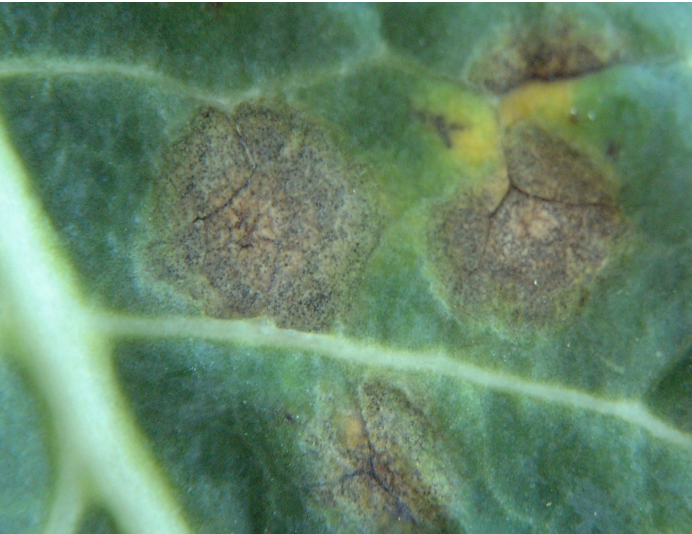
It produces dark spots scattered across the leaves with characteristic rings of dark fruiting bodies. Lesion margins are yellow, and leaf yellowing and early leaf drop occurs as RS progresses. RS is easily confused with Alternaria, and needs microscopic examination to differentiate
Importance
Can cause significant damage in some years to some crops.
Spread
RS overwinters in crop debris, on weeds or volunteer brassicas. Spores are produced in spring, infecting leaves and seed pods. Seed transmission is not deemed significant.
Prevention & management
Use certified machine cleaned seed to ensure no new source of infection. Good cultivation and crop rotations ensure low levels of crop debris and weeds for RS to over-winter on. Graze infected plants early to limit disease spread.
Sclerotinia (SC)
SC, also known as watery soft rot, is caused by the fungal pathogen Sclerotinia sclerotiorum, with many hosts including all brassicas. Infection occurs from air-borne spores or from over-wintering sclerotia (dormant survival spores) in the soil.
Identification
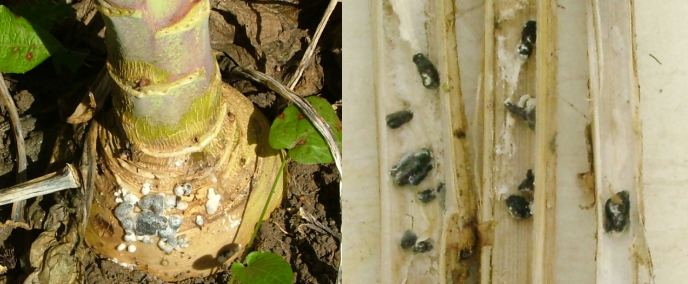
SC causes a soft watery rot of stems and bulbs. It produces extensive white mycelium under humid, wet conditions, and black, overwintering sclerotia develop on and in diseased tissue.
Importance
In many crops, only scattered infected plants are seen. But SC can build up in areas where consecutive susceptible crops are sown.
Spread
It can survive in the soil for several years, and spreads by physical contact with infected tissues or by air- borne ascospores. These ascospores are produced from sclerotia in the soil and infect flower petals, which subsequently infect crop leaves when they fall. Thus, patches of infection can occur in dense moist crops. Sclerotia are often the same size and shape as brassica seeds, so contaminated lines can account for introduction into a crop.
Prevention & management
Sow machine cleaned and certified seed and maintain good crop rotations to minimise SC. Good cultivation is also essential, to ensure crop debris is broken down and out of the planting zone when re-sowing into crop
Viruses
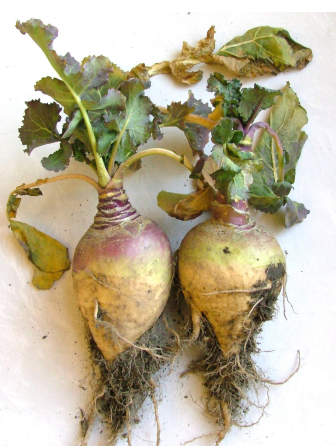
The three main brassica viruses are turnip yellows virus (TuYV), formerly beet western yellows virus; cauliflower mosaic virus (CaMV) and turnip mosaic virus (TuMV). All are common in brassica crops throughout NZ.
Identification
TuYV is characterised by colouring in the leaves, especially purples and reds, which eventually turn yellow. CaMV and TuMV cause similar symptoms to each other (tests are often required to differentiate).
Infected plants show patterns, distortion and mottling in the leaves.
They are stunted and often die if infection occurs early.
Importance
Early infection with any of these viruses can cause severe crop losses.
Spread
All are introduced into crops by aphids. The two main aphid species in brassicas, the green peach and grey cabbage aphid, are the main vectors. The main sources of these viruses are nearby weeds and brassica volunteers.
Prevention & management
Good aphid control is necessary to limit viruses. Seed beds should also be kept free of host weeds and volunteers, such as wild turnip. Seed treatments such as Agricote Brassica can give seedlings up to 6 weeks protection, often long enough to cover the critical period when aphids are flying. Aphicides can be used, but correct timing is hard to achieve.
White blister (WB)
WB is a common disease of weed brassicas that can spread to crops, caused by the fungus Albugo candida. WB does not generally cause major damage in brassica crops although radish can be heavily infected.
Identification
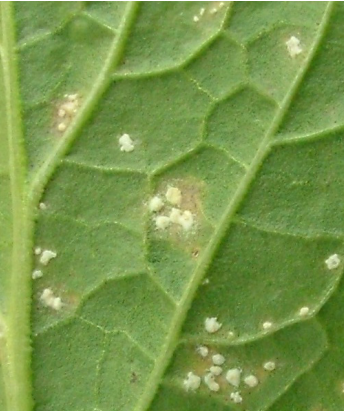
White blisters form on the underside of leaves that produce white spores.
Chlorotic spots occur on the upper leaf surface. Infection of the seed stalk and head produces twisting and swelling (called ‘stag’s head’). Leaf infection is often found with downy mildew.
Importance
WB is uncommon in leafy turnips.
Spread
Spores are readily airborne, with cool wet conditions favouring WB development. Seedlings are particularly susceptible. WB over-winters on volunteers and weeds. Seed can be contaminated by oospores of the pathogen.
Prevention & management
Sow machine cleaned and certified seed to minimise infection, and control weeds. If young crops are infected, a light grazing may reduce infection.
Barenbrug wishes to acknowledge the help of Plant Diagnostics and Plant & Food Research in producing this section.