Assessing fodder beet yield
Quantifying crop yield before feeding helps ensure the correct transition and daily DM allowance. DM percentages vary widely between paddocks, so always measure – don’t estimate.
Crop allocation
For transitioning, assess crop yield at the end of the paddock where livestock will start grazing, because correct crop allocation is paramount during this time.
How to assess yield
- Determine the crop row spacing: Measure across 10 rows of the crop from the centre of the first row to centre of row 10; divide the distance by 9.
- Take at least 5 separate yield samples that represent the area being measured.
- For each yield sample: Sample a 2 m2 area. For a 50 cm row spacing remove 4 m of a row; or 4.44 m for an 45 cm row spacing.
- Measure fresh-weight: Remove soil from the bulbs by scraping with a blade, separate the leaf and bulb by cutting as close to the crown of the bulb as possible, and weigh the leaf and bulb separately.
- Collect DM sample: Select approximately 300 g of representative leaf from multiple plants and place in a sealed, airtight plastic bag. Use a corer to sample through at least 12 separate bulbs and place cores into a separate sealed, airtight plastic bag. Send samples to lab for DM determination.
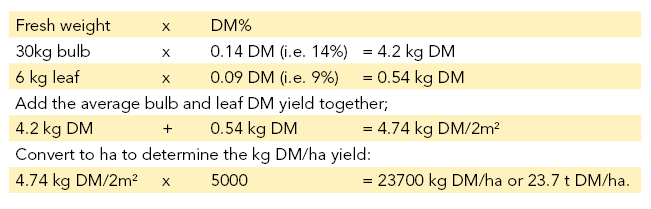
Calculate the DM yield for each separate sample, and plant part, then average as in the following example.
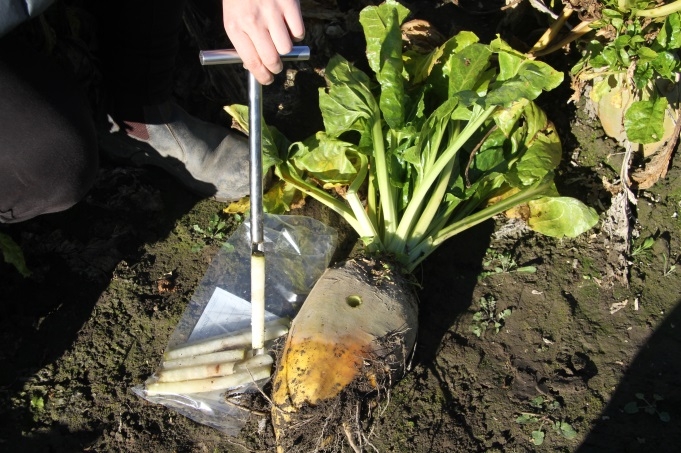
Example of calculating yield