
Fodder beet diseases
This section lists a range of diseases to help you identify them and their importance. Good planning and crop rotation reduce the risk of disease. Monitor growing crops so you can take appropriate action early. Fodder beet crops are susceptible to various diseases that can significantly impact yield and quality, including fungal, bacterial, and viral infections. Effective management through early detection and proper agricultural practices is essential to minimise damage and ensure healthy, productive crops.
Alternaria & Stemphylium leaf spots
Lesions caused by Alternaria brassicae, Alternaria tenuis and Stemphylium botryosum commonly affect leaves already weakened by other causes such as virus.
Identification
Infection begins as small dark spots in already yellowed areas of leaves, especially at leaf margins. Lesions are dark brown to black and can appear velvety black with heavy sporulation. Old leaves weakened by age, disease or stress are colonised first.
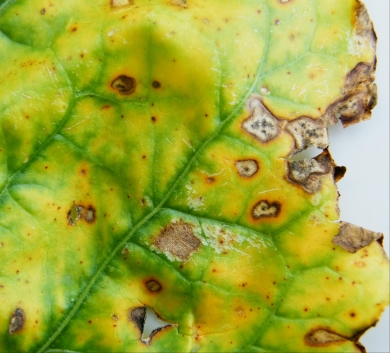
Alternaria sp. lesions on a virus-infected beet leaf.
Importance
These fungi worsen damage from virus infections and deficiencies, significantly reducing green leaf and DM yield.
Spread
Spores produced on the lesions are readily dispersed by wind. Cool, humid conditions favour infection.
Management
Alternaria and Stemphylium leaf spot mostly occur in mature crops with older, senescent foliage, so management is difficult. Monitor irrigation and fertility to reduce plant stress and limit potential disease development. Some fungicides are registered for Alternaria control.
Bacterial leaf blight (BLB)
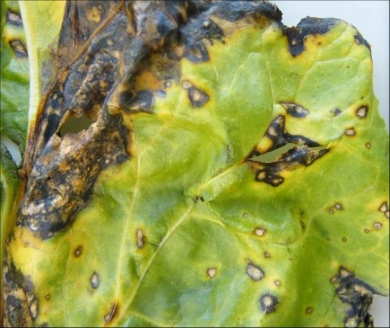
Bacterial leaf blight (BLB) is caused by the bacterium Pseudomonas syringae p.v. aptata and can affect both leaves and bulbs.
Identification
Dark greasy leaf lesions, often with lighter brown areas and centres, commonly occur on leaf margins where bacteria have accumulated. Seed borne infection can cause seedling blight.
Importance
Common in fodder beet crops. Severe infection reduces green leaf area and bulb dry weight.
Spread
Primary infection often arises from seed-borne inoculum or via volunteer host plants and crops. Water splash, stock and machinery spread the disease.
Bacteria can also survive on crop debris.
Management
Always sow seed from a reputable source, avoid excessive foliage wetness and follow good crop rotation practices.
Beet rust (BR)
Beet rust (BR) is a foliar disease caused by the fungus Uromyces beticola. Heavy infection cuts bulb yield.
Identification
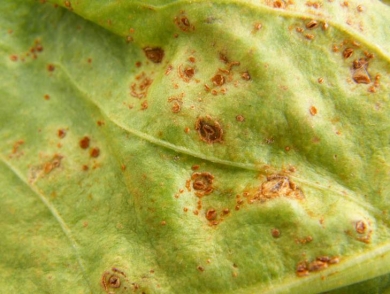
BR produces orange-brown pustules on both surfaces of beet leaves, sometimes in a circular pattern. In some cultivars, lesions surround the pustule.
Importance
Typically not a major problem in feed crops. Infection is restricted to older leaves. However, under prolonged moist, mild weather, BR can cause substantial leaf damage and DM yield loss.
Spread
U. beticola survives between crop cycles on infected plants (mostly volunteers) and in crop debris. Spores are produced in spring and transported by wind.
Management
Control volunteers. Fungicides are available.
Cercospora leaf spot (CLS)
The fungus Cercospora beticola affects both leaves and bulbs, with potentially serious yield losses.
High temperatures and humidity, typically in late summer, increase damage.
Identification
Small round leaf spots (3-5 mm diameter) are first found on older leaves then transfer to younger leaves. Tan to light brown centres have reddish-brown borders.
In heavy infections, spotscoalesce and leaves turn brown but stay attached to the plant.
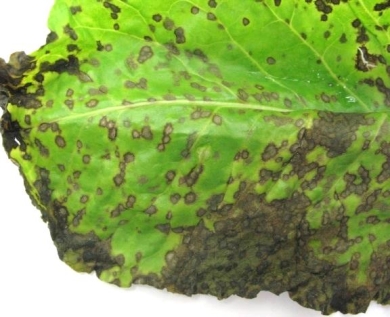
Cercospora leaf spot.
(Photo: M. Braithwaite, Plant Diagnostics Ltd.)
Importance
CLS occurs sporadically but can result in significant DM loss.
Spread
CLS survives between crops via residues, soil, seed and infected plants. Spores are produced in spring and transferred by wind, water splash, insects and equipment. Spread is greatest when leaves are wet at night and days are warm and humid.
Management
Rotate crops every year. Sow seed only from reputable sources. Use treated seed. Keep infected residues 100 m away from other susceptible crops. If irrigating, avoid prolonged leaf wetness; water from mid-day when leaves are dry. Fungicides are available.
Downy mildew (DM)
Downy mildew (DM) in fodder beet is caused by Peronospora variabilis.
Identification
DM mainly affects younger leaves as rosettes. Systemically infected leaves are stunted, distorted, thickened and light green with curling margins. Such plants usually die. In cool, humid weather masses of fruiting structures and spores turn leaves purplish grey.
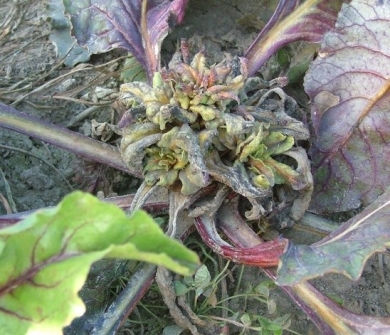
Red beet rosette infected with downy mildew.
Importance
Occasionally seen in fodder beet crops; reduces plant density.
Spread
Initial infection stems from infected and contaminated seed; over-wintering spores in the soil or from nearby infected crops or volunteer plants. Spores can also spread via wind over long distances.
Management
Rotate crops to eliminate volunteer hosts and soil- borne inoculum. Use seed from a reputable source. Seed treatments can be used.
Fusarium (damping off, root/bulb rot)
Various Fusarium spp. cause beet damping off and root and bulb rots.
Identification
For damping off symptoms, refer to Rhizoctonia. Bulb rot presents as white to pink masses of spores at soil level and on the bulb. Internally, brown tissue necrosis is similar to that of R. solani. Root rots show as dark brown lesions and tip die-back.
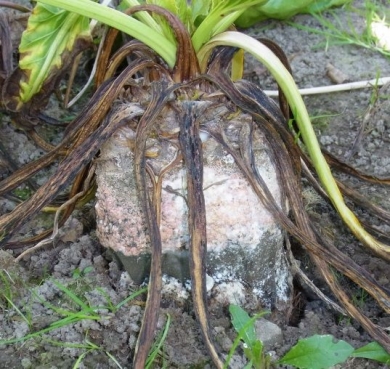
Bulb rot caused by Fusarium spp.
Importance
Damping off caused by soil-borne Fusarium spp. together with other pathogens can occasionally cause significant plant loss at establishment. Fusarium bulb rots can occur in the absence of break crops.
Spread
Fusarium spp. can be both soil-borne and rain- splashed. Spores can remain viable in the soil for many years without a host, and can also be spread by stock and machinery.
Management
Allow at least 3 seasons between crops if infection occurs. Restrict movement of soil via machinery and livestock from infected fodder crops.
Phoma (damping off, leaf spot and crown rot)
The fungal pathogen Neocamarosporium betae (formerly Phoma betae) can cause a range of symptoms in fodder beet crops.
Identification
For damping off symptoms, see Rhizoctonia. Leaf spots are light brown and round to oval, often with concentric rings. Small, dark fruiting bodies form in the necrotic tissue as lesions age. Bulb rot manifests as brown to black necrotic crown rotting.
Importance
Occurs occasionally.
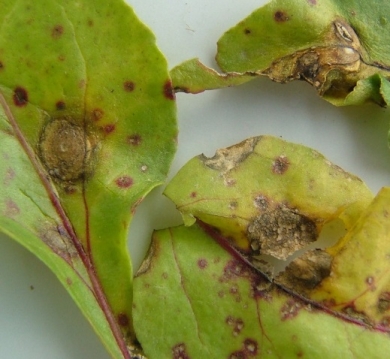
Phoma leaf spot on beet.
Spread
Infection is mostly seed borne but the fungus can survive in crop debris and soil for 12–20 months. Spores spread by water splash.
Management
Always use seed from a reputable source, and rotate crops for 1-2 seasons if disease occurs.
Powdery mildew (PM)
Powdery mildew (PM) is caused by the fungus Erysiphe betae.
Identification
First signs are small white powdery patches on the upper surface of older leaves. Severely infected plants turn greyish-white. Leaves then yellow and eventually die.
Importance
Currently minor in fodder beet.
Spread
PM requires a living plant host to survive winter.
During spring, wind-blown spores infect new leaves, plants and crops under dry, warm conditions.
Management
Infection under ideal conditions is relatively rapid, with control becoming less effective with time. Fungicides are available.
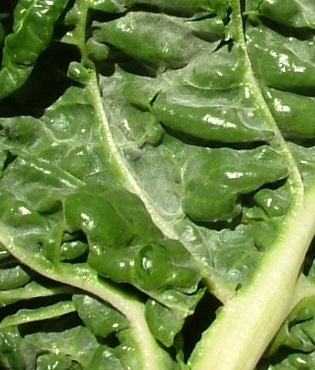
Early powdery mildew infection on a sliver beet leaf.
Rhizoctonia (damping off, foliar blight and bulb rot)
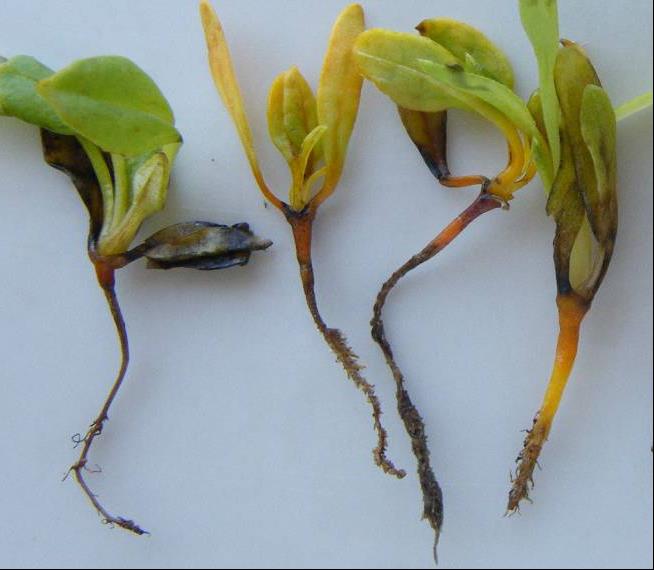
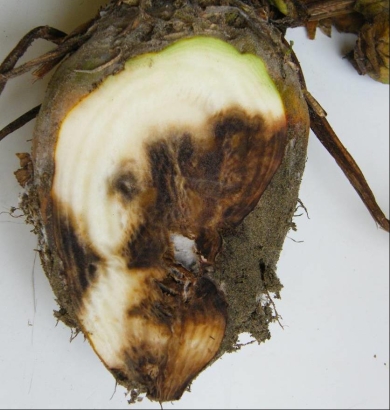
The soil borne fungus Rhizoctonia solani is a major disease in fodder beet, causing seedling damping off, foliar blight, and bulb rot, leading to leaf and plant death
Identification
|
|
Infection by R. solani is difficult to differentiate in the field from other causes of damping off and bulb rot. Laboratory identification is possible.
Damping off: Early infection is characterised by dark lesions at soil level that increase in size to girdle the young stem. Plants then wilt, collapse and die.
Bulb rot: At and below ground level, the fungus invades through small wounds and cracks, progressing to cause large areas of dead tissue. Plants wilt and can eventually die. The pathogen can progress to kill petioles and leaves. Sometimes, smoky-coloured fungal strands (hyphae) can be seen growing in internal cracks in the affected bulbs.
Importance
This is a major disease of fodder beet throughout NZ.
Spread
R. solani commonly occurs in heavy, poorly drained wet soils. The pathogen survives in the soil as fungal threads (mycelium), resting structures (sclerotia) and in plant debris. Second year crops are especially vulnerable to infection. Cultivation and movement of soil from infected paddocks on machinery and livestock also helps spread the disease. Note: R. solani has a wide host range. The strain associated with beet (AG 2.2) also infects maize and grasses
Management
Correct crop rotation is critical once the disease has been identified in a paddock. Select free draining paddocks to help reduce the risk.
Ramularia leaf spot (RLS)
Ramularia leaf spot (RLS) is caused by the fungus Ramularia beticola.
Identification
Symptoms are similar to Cercospora leaf spot. Older leaves are infected first. Light brown round to angular spots (4-7 mm) mature to dark brown, with silvery grey margins turning white upon sporulation. Lesions then become entirely white. Infected leaves turn yellow and die.
Importance
Occurs only sporadically.
Spread
Spores spread via wind and water splash. Mild temperatures and humid conditions favour spore germination.
Management
Weather affects RLS severity; warm, dry conditions help crops recover. Dense crops are more susceptible to damage, as are those deficient in sulphur. Fungicides are available.
Beet mosaic virus (BtMV)
Beet mosaic virus (BtMV) can be present in association with other viruses and causes less damage than viruses within the virus yellows complex, but can be harder to control.
Identification
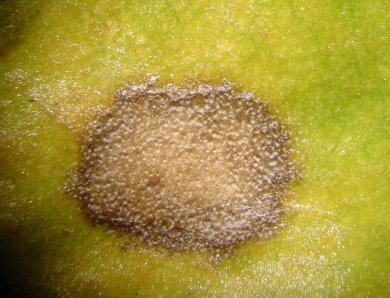
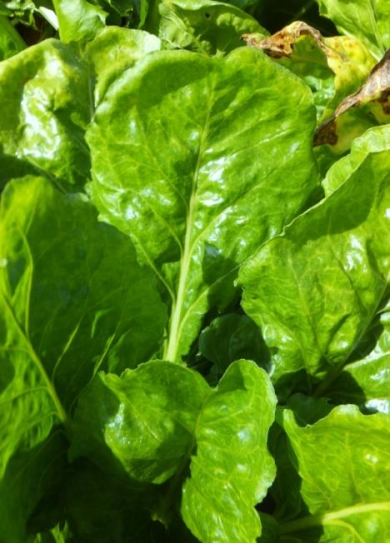
Light green chlorotic spots and mottles appear on younger leaves first, in a circular pattern often with sharply defined margins. Chlorotic rings develop on older leaves with or without green centres.
Infected leaves become stunted and distorted.
Importance
Up to 7% incidence of infected plants detected in infected crops in a 2016 survey in the North Island and up to 16% in the South Island although its current importance and incidence is not known. BtMV is aphid and mechanically transmitted.
Spread
Aphids are the primary source of infection. Feeding aphids acquire and transmit the virus very quickly (within minutes of starting feeding). However, aphids only retain the virus for a few hours after ceasing feeding. The virus can also be transmitted by sap between plants.
Management
BtMV can occur on beet weed hosts, so good weed control is important for disease management.
Overlapping crops of beet and volunteers can also be important sources of infection. Spraying aphids to control disease transmission is not practical. Insecticidal seed treatment may offer some early protection. No source of resistance is readily available.
Virus yellows complex (VYC)
Virus yellows complex (VYC) describes a disease caused by members of the Polerovirus genus.
This includes beet chlorosis virus (BChV), beet mild yellowing virus (BMYV) and potentially beet western yellows virus. Other viruses within this group may also be involved and mixed infections are common. Virus yellows complex commonly occurs on beet in NZ. Secondary fungal infections particularly by Alternaria and Stemphylium are often associated with these viruses.
Identification
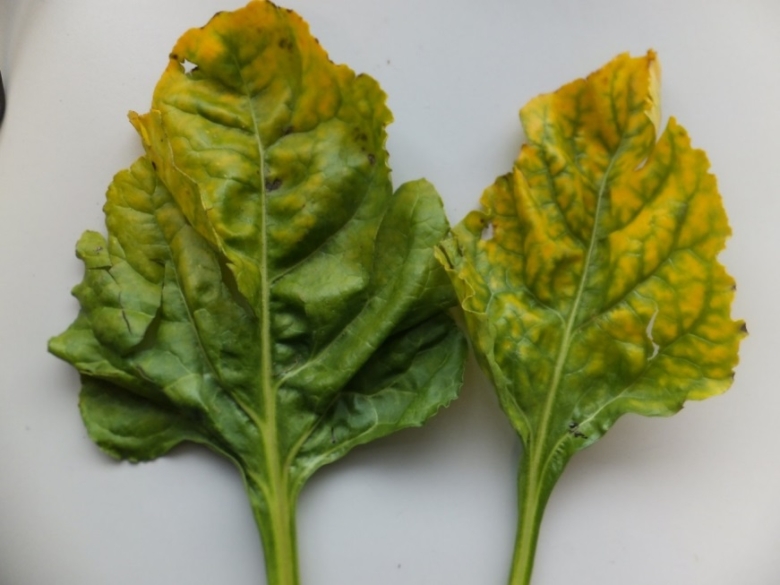
Yellowing of the leaves between veins spreads within foliage. Leaves become thicker and brittle leading to death. Note that symptoms can be confused with nutrient deficiencies.
Secondary interveinal necrosis also occurs as the plants age.
Importance
Virus yellows complex can cause major losses in fodder and in sugar beet. Large patches of plants in crops can be affected. These virus diseases cut leaf quality, palatability and yield.
Spread
Virus yellows complex is only spread by aphids, mainly the green peach aphid. Aphids can acquire the virus after feeding on sap for 5–10 mins on infected plants but usually take an hour or more to become highly infectious. Most transmission takes place 6–12 hrs after feeding starts, although aphids can retain the virus for up to 17 days.
Management
Because of the time it takes for virus infection to be transmitted by aphids, insecticide can be effective. Insecticidal seed treatment controls aphids during crop establishment. This should be followed up by close crop monitoring to detect any build-up in aphid numbers, and timely application of insecticide if needed.
Controlling weeds that can harbour aphids helps reduce the risk of infestations, together with aphid control in neighbouring beet crops. Aphids from these sources can colonise beet crops and spread infection through the stand.
No good source of resistance is reported to be available for virus yellows complex in fodder beet.
Aphid flights mainly occur in late spring (Nov to early Dec) and autumn from mid April to late May. Thus delayed sowing and monitoring of crops in autumn can help manage this disease.
Barenbrug wishes to acknowledge the help of Ian Harvey and John Fletcher (Plant & Food Research) in producing this section and providing photographs and Plant Diagnostics Ltd for contributions.
Robbos
-
Excellent, consistent performer
-
Bulbs typically sit 45-50% above ground
-
Consistent high Dry Matter yield