
Transitioning animals onto fodder beet
It can take up to 3 weeks to transition animals properly onto fodder beet, and 7-10 days to transition off. Both require careful management. This information is a guide. Seek further advice if required.
Transition planning
How the crop is to be fed should determine the planting layout. Provide good access for animals and allow enough room for the entire mob to get on the crop, without over-allocating the amount of feed. This can be a challenge in very high yielding crops in early stages of transition.
One way to achieve this is to plant a greenfeed crop in a headland (e.g. 6 m wide) parallel to the rows of fodder beet. The greenfeed can be used during transition as an alternative feed source, which is not high in readily fermentable carbohydrate. Alternatively fodder beet in the headland can be lifted mechanically or manually and fed to the animals at a low level to start transition. Both options help ensure enough space is available for animals in the fodder beet paddock to manage transition.
Typically, grazing occurs parallel to the rows to make allocation of feed easier. Long narrow breaks, where animals are eating under the wire, are best as this helps ensure that animals have equal access to the crop and none is pushed to the back. It also improves crop utilisation, with less treading of the crop.
Transition in practice
Dairy Cows
For mature dairy cows it is advised to start transition by allocating 1-2 kg DM/day per animal and gradually increase the amount of fodder beet offered by 1 kg DM every 2 days until the desired allocation is reached. This will take 14-21 days depending on the final allocation. In early transition a high proportion of supplement will be required, and this will decrease over the transition period as fodder beet intake increases. Supplement should be fed in the three hours before fodder beet to ensure good gut fill. This will slow the rate of fodder beet intake and minimise gorging.
For the first days of transition, fodder beet is often lifted and fed to stock (e.g. on grazed pasture) as it is hard to ensure very low intake levels of all animals when break feeding, because some dominant cows may gorge themselves.
During this early stage, monitor animals closely. Ensure they are eating everything allocated to them, and do not let a bank of uneaten bulbs accumulate in previous breaks. Individual animals transition at different rates, so even with a good transition process rumen acidosis can still occur. If animals show any signs of acidosis, remove them from the crop straight away. Drenching with sodium bicarbonate (baking soda) can help increase the rumen pH. Contact your vet for further advice.
If animals are off the crop for more than 2 days re-transitioning will be required, the speed of which will be determined by how much they were being offered previously.
R2 heifers & steers
For R2 heifers and steers it is advised to start by allocating 1 kg DM/day per animal, and gradually increase allowance as outlined above for mixed aged cows.
R1 heifers & steers
Transition timing for R1 heifers and steers is the same (14-21 days), however feed quantities are halved. It is advised to start by allocating 0.5 kg DM/animal/day on day 1, then increase by 0.5 kg DM every 2 days until the desired allocation is reached. Vaccinate all R1s for clostridial diseases (e.g. 5 in 1) before going onto fodder beet. Young growing animals have a higher demand for protein, so this should be fed as a supplement to calves grazing fodder beet (e.g. high quality grass silage).
Deer & beef cattle
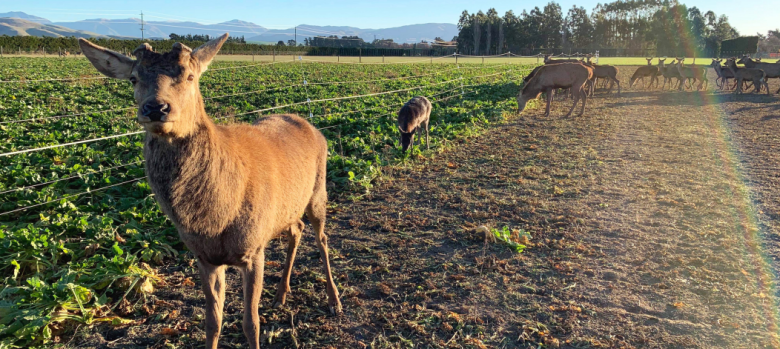
Deer and beef cattle which are to be ad lib fed on fodder beet are less susceptible to rumen acidosis once transitioned because they graze over a 24 hour period, rather than eating an allocation of fodder beet in 4-5 hours. However, deer and beef cattle do require a 14-21 day transition onto fodder beet.
Sheep
Sheep do not require the full 14-21 day transition phase. They can be transitioned by giving them access to fodder beet for a few hours each day for 3-4 days and then locking them on the crop. Ensure all sheep are fully vaccinated for clostridial diseases (e.g. 5 in 1) before grazing fodder beet.
Young sheep
For animals new to fodder beet, particularly younger stock, transitioning may require the bulbs to be chopped or smashed before the stock will try them. This can be done with a Cambridge roller. Fodder beet is not typically fed to lambs.
Plan ahead
Winter grazing practices are changing in New Zealand, for both environmental and animal welfare reasons. Before sowing, check paddock contour, size, slope, critical source areas (CSAs), soil type, stock access, water access, grazing pattern and nutrient loss buffer zones. For more detail on best practice winter grazing, visit www.dairynz.co.nz , www.beefandlamb.co.nz