
Tetraploid seeds
Some ryegrass, red clover and brassica cultivars are tetraploids. Tetraploids have larger seeds than diploids, so they must be sown at higher rates.
In perennial and hybrid ryegrass, tetraploids need different management for best performance (see Using tetraploid perennial ryegrass and Mixing tetraploid & diploid ryegrass).
What is a tetraploid?
Ryegrass, red clover and brassicas occur in nature as diploids, meaning each cell in the plant has 2 sets of chromosomes. Tetraploids have been developed by plant breeders using controlled mutation from a standard cultivar (diploid) to double the number of chromosomes in each plant cell.
This practice was first developed in Holland in the 1960s and has now become common in plant breeding. It does not involve gene modification.
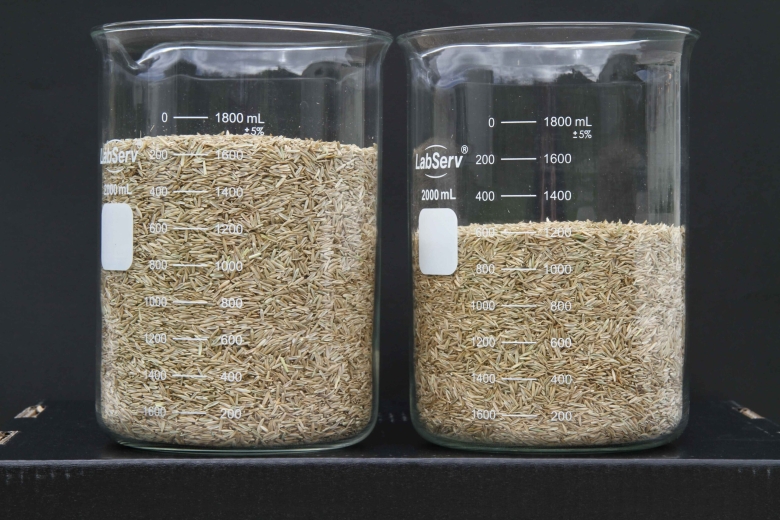
Tetraploid characteristics
Tetraploiding creates larger cells, leading to larger plants and larger seeds. Their increased cell size means tetraploid plants have a higher ratio of soluble carbohydrates (cell contents) to fibre (cell wall), improving animal preference and performance over diploid cultivars.
Tetraploids can be identified by their large, darker leaves, and may visually appear superior to diploids. However, they tend to have 10-20% less dry matter content. Tetraploid seeds are larger than diploid seeds and because of this, a higher sowing rate is required to obtain a similar number of seeds per hectare.
Feed value
Tetraploid perennial ryegrasses are more palatable and digestible than diploids, increasing animal intake. However, they are less robust, and don't fit all farm systems
Tetraploid annual and Italian ryegrasses
Tetraploiding annual or Italian ryegrass appears to have little affect on their palatability because they are already very palatable as diploids.