Maximising white clover
White clover is a key element of our farm systems thanks to its high feed value, warm season growth and natural ability to fix nitrogen.
It is more difficult to establish in a pasture than grass, however. Take care with soil fertility, sowing technique and cultivar choice. Clover content is also greatly influenced by on-going pasture management.
Soil fertility
Correct soil fertility is a must. Clover is sensitive to soil pH, growing best at 5.8-6.2. Ensure adequate levels of phosphate, sulphur and molybdenum. If lack of clover is on-going, test the herbage of clover plants present to help find answers.
Establishment
Careful establishment helps white clover thrive.
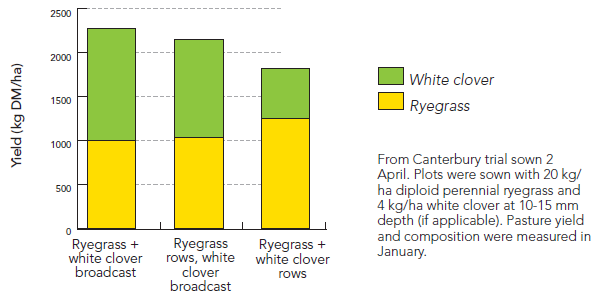
It has a small seed, requires shallow sowing (<10 mm), and is often sown too deep. Drilling ryegrass and clover in the same row through a coulter drill means competition from the faster establishing ryegrass suppresses clover (see graph below). Where possible don’t sow ryegrass and clover together in rows. If cultivating, roller drills are ideal. If your drill (or your contractor’s) has a separate small seed box, one option is to order your clover seed separately, sow it through this, then roll.
Sowing method
In this trial, white clover and ryegrass were sown using three widely used methods. Nine months after sowing, broadcasting white clover seed gave on average 20% more clover in the pasture than drilling with ryegrass in a row.
White clover and ryegrass DM yields from different sowing methods
Maintaining good clover
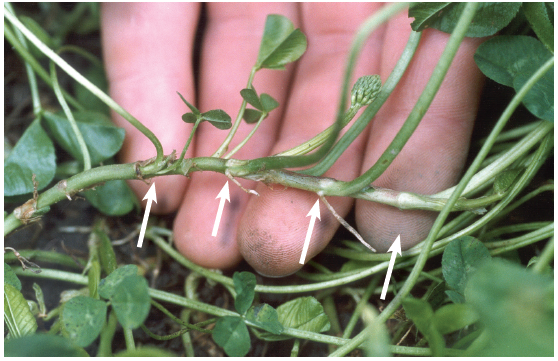
Once established, white clover will perform best under rotational grazing, so it is frequently exposed to sunlight, not shaded out under high grass covers. White clover is also preferentially grazed by stock, so continuous set-stocking often leads to over grazing and reduced clover levels.
Cultivar choice
We recommend two main clover mixes, one for dairy and cattle grazing, the other for sheep and deer. These both contain cultivars of two leaf sizes, for greater adaptability to climate, topography and management.
Kotuku/Ruru - Dairy/beef
This is a high yielding combination, performing well across a range of conditions. Kotuku, with its large leaf, fast establishment, and high summer and autumn growth, is complemented by Ruru, which has a medium leaf, high stolon density, early growth and persistence (refer to Kotuku and Ruru).
Ruru/Apex - Sheep/Deer
This combination has smaller leaves, and better tolerates close grazing while still providing very good warm season production. Ruru with its medium leaf is complemented by Apex with a small leaf. Both have shown good tolerance to summer dry conditions or under clover root weevil attack (see Apex).