
How much should you renew?
The correct amount of renewal for your farm depends on how your pastures are performing, and how fast you want them to improve. This section covers how to assess this and plan accordingly.
Amount of renewal
Pasture renewal programmes vary widely across NZ, ranging from 0% to over 30% of the farm area each year. Dairy farm renewal averages about 10% compared to 3-5% on sheep farms.
Often the amount of land renewed is a set figure in the farm’s annual budget. But it shouldn’t be. Renewal should be flexible, and weighed against other investments. For example, on one farm we assessed, a programme to immediately renew over 30% of the property was undertaken, as the poor performance of existing pastures made this a very profitable investment1.
Benefit of renewal
The benefit of new pasture is the gains it will deliver over existing pasture. So, you need to estimate the current pasture performance versus potential.
Current pasture growth
Pasture growth varies widely between individual paddocks across every farm. On flat farms there is typically a 100% difference in DM yield between best and worst paddocks. This difference is higher on hill country.
Growth differences between dairy paddocks of 4 t DM/ha are common. This means under-performing paddocks may produce 250 kg MS/ha less than better ones (based on 75% utilisation and 12 kg DM/kg MS conversion). On a sheep and beef farm the poorest paddocks could be carrying 30-50% fewer stock with much slower animal growth rates.
Measuring paddock performance
Comparing the performance of individual paddocks allows you to quantify the potential gains of pasture renewal on the farm. The best paddocks show what can be achieved, with the difference between those and the worst illustrating the potential for improvement, provided paddocks share similar topography, soil type etc.
One way to find out how much individual paddocks grow is to record stock grazing days. For more advice on doing this, visit www.barenbrug.co.nz
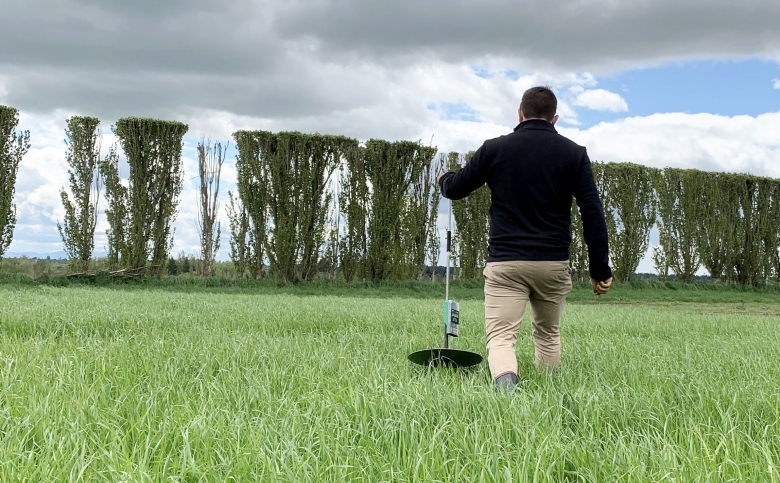
Alternatively you can use a plate meter or visual yield estimates from farm walks to estimate pasture cover to calculate paddock growth. Most computer software does this automatically from weekly pasture cover data.
Create a paddock profile
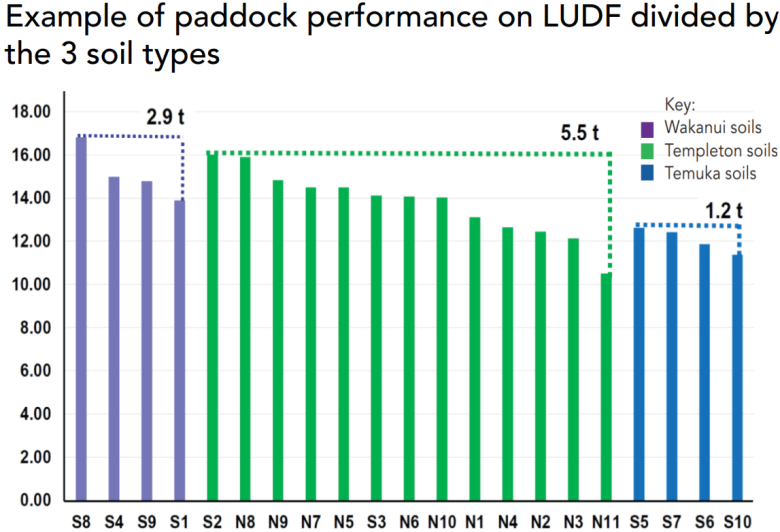
Next, paddock performance data can be used to rank paddocks within their productive group (e.g. different soil type, topography etc). This example is for the Lincoln University Dairy Farm (LUDF), which has three different soils marked by different colours.
Each soil type has different productivity, so you need to compare like with like. This reveals the relative performance of paddocks within a soil type, for example N11 produced an estimated 5.5 t DM/ha less than it should. It also shows that although S10 doesn't grow well, renewal is unlikely to give large benefits.
Just as you identify and cull the tail end of your herd or flock to improve animal performance, here the same thing is done with pasture, renewing tail end paddocks to lift farm pasture performance.
Low hanging fruit
While the graph above shows the potential gain from renewal, it’s also important to look at the cost or difficulty in realising those gains. The best return from investment in pasture renewal comes via significant yield gain achieved at a low cost. Look for your worst performing paddock(s) on the most productive part of the farm.
For example, on the LUDF, DM yield gains are much easier to achieve on the purple or green soils. Large gains on the poorly drained blue soils would require drainage work, with significant costs.
Evaluate success
Continue to assess paddock performance after renewal so you can evaluate your success. Typically pasture renewal delivers good gains. If this is not the case, underlying reasons for poor paddock performance probably have not been rectified. Continual evaluation allows you to fine-tune what works best for your particular system.
Capture benefits of new pasture
New pasture grows more so:
- More fertiliser will be required.
- A higher stocking rate may be needed.
- Different management may be needed.
1 A more quantitative approach to pasture renewal. Journal NZ Grasslands 77: 251-258 (2015).