
Feed quantity and lamb growth
Pasture yield at lambing directly affects lamb growth. When feed quality is generally good (March-October), feed quantity drives the performance of many livestock systems.
Effect on suckling lambs
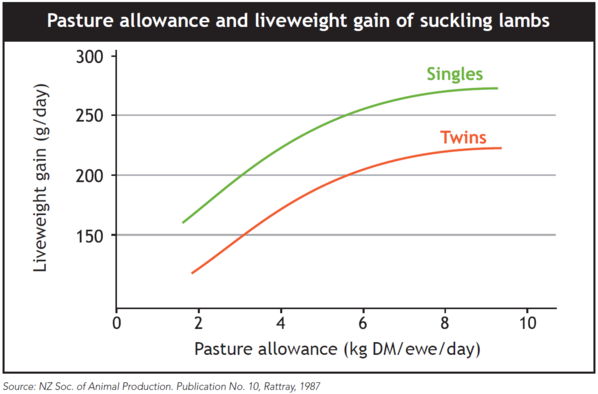
At lambing in early spring feed quality is typically good, and feed quantity is the key driver of lamb growth. To achieve the best lamb growth, target pasture covers through lactation should be 1200 kg DM/ha+ (about 3 cm+ in height) for single lamb bearing ewes, and 1500 kg DM/ha+ (about 4 cm+) for ewes bearing twins.
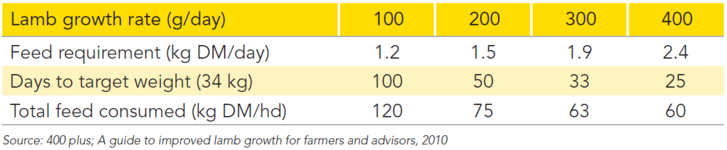
Post weaning, feed quantity continues to be a key driver of lamb growth, as shown below.
Feed requirement of lambs 24-34 kg
Greater efficiency
The above table shows the faster lambs grow, the more efficient the system is at turning feed into liveweight. That’s because lambs growing at 100 g/ day require energy to live, breath and function (maintenance energy) for 100 days, whereas lambs growing at 400 g/day only need maintenance energy for 25 days. This frees up 75 days to utilise the feed in other ways.