
Establishment techniques – Fodder beet
Fodder beet is a specialist crop and is more intensive and expensive to grow than other forage crops.
It can produce high DM yields, but these vary widely. With good establishment techniques, management and moisture, fodder beet can produce 30 t DM/ha. Typical yields are 18-24 t DM/ha. In summer dry situations yields are lower.
Pre-sowing
Fodder beet is sown at a very low sowing rate compared to other forage crops, so a firm, even, weed free seedbed is essential for optimal germination. Fodder beet is particularly vulnerable to dry conditions and competition from weeds during establishment. Use a ‘stale’ seedbed to reduce this risk.
To achieve a stale seedbed, spray out the selected paddock(s) with appropriate herbicide/s 4-6 weeks before planting. This gives time to implement a double spray programme and retains soil moisture.
Paddocks are typically ploughed to bury existing plant material and break up any compaction or sub-soil pans, then surface cultivated to produce a firm, even seedbed. A second non residual weed spray (e.g. glyphosate) can be applied just before sowing, or included in the pre-emergence application just after sowing.
Sowing date
This is location and season dependent, but in general October to late November is recommended, once soil temperatures are consistently above 10oC. Sowing too early (< 10oC) can result in uneven germination, making spray timings difficult. It can also risk vernalisation, causing plants to flower prematurely in late summer, known as ‘bolting’. Later sowing may jeopardise germination rate (due to lack of soil moisture) and shortens the growing season, reducing yield potential.
Precision sowing
Fodder beet should be precision sown. This ensures seeds are planted with appropriate spacings, enabling each bulb to grow to its potential. Sow seed 15-20 mm deep, with rows typically 500 mm apart and 250 mm between plants in the rows (depending on sowing rate and planter row spacing). Drilling speed needs to be slow (e.g. 5 kph) to ensure accurate seed placement. How the crop is to be fed should determine the planting layout.
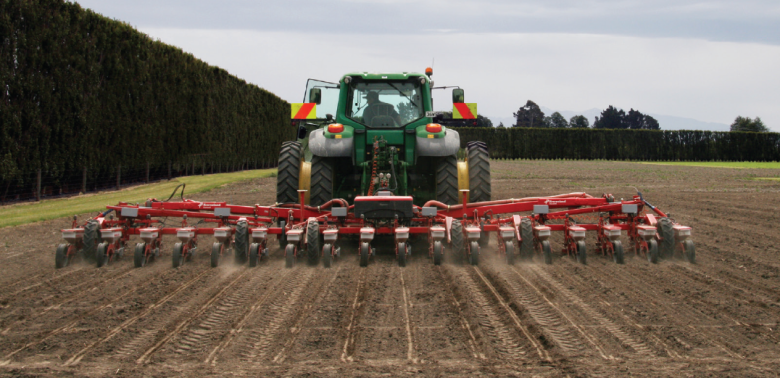
Strip tillage is also used for fodder beet, to reduce soil disturbance, weed germination and wind damage to establishing plants.
Fodder beet is normally sown at 80,000 seeds/ha for grazing, or 100,000 seeds/ha for lifting. This higher rate produces more uniform bulbs which are easier to harvest.
Roll the paddock immediately after drilling with a Cambridge roller to maximise seed to soil contact for more even germination, and to improve the effectiveness of pre-emergence herbicide.
Weed/pest control
Seedlings are slow to establish so the crop is susceptible to early weed competition and pest damage. A stale seedbed will get the crop off to a good start, but alone it rarely provides enough weed control.
The first herbicide is typically pre-emergence, applied immediately after sowing. Insecticide can also be incorporated. Follow this with selective post-emergence herbicides as needed until canopy closure. Seek professional advice on herbicide choice, rates, timing and plantback withholding periods.
Fodder beet is very resistant to most brassica pests, except for Nysius, slugs and springtails which are typically found at drilling. See brassica pests and pasture pests for more information on these.
Bolters
A fodder beet crop usually has a small population of plants which flower prematurely (known as bolters). Remove these in January or February before they drop seed in the paddock. Left uncontrolled, they will each drop up to 1500 seeds which can survive in the soil for many years and germinate as the soil is disturbed. These areas can become thick with weed beet in future years, depressing future crop yields. You can reduce bolters by not sowing fodder beet too early.