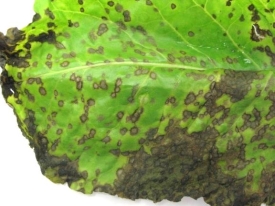
Brassica pests
This section lists a range of insect pests, to help you identify them and their importance. Pests can cause severe damage to both foliage and roots, so good management strategies are crucial for protecting crops.
Aphids (Brevicoryne brassicae)
Aphids are pests of brassica crops throughout NZ, but occur more frequently in the South Island. They damage plants by sucking plant juices and transmit several plant viruses.
Identification
Of the many aphid species present in NZ, the most significant for brassicasare the grey cabbage and green peach aphid.
Adult females can be both winged and wingless.
Wingless adults are around 2 mm long and 1 mm wide, tapering at each end. They range from yellow to dark green or grey in colour, and can be covered in a whitish waxy powder.
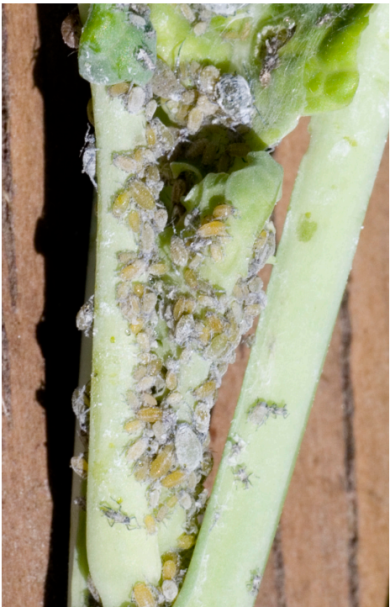
Winged adult aphids have 2 pairs of strongly veined wings which extend well beyond the body when the insect is at rest. They are around 2 mm in length, and range from yellow through to grey, with more pronounced black markings on the back and virtually no white waxy powder.
Aphids damage plants by sucking plant juices, targeting mostly young leaves. This causes leaves to yellow and curl. Affected plants are stunted and wilt, especially in hot weather. Aphids also transmit plant viruses, including turnip mosaic virus (see Brassica diseases), which stunts plant growth.
Heavily infested brassica crops may become unpalatable to stock, worsening feed losses. Aphids are most active from October to January, with populations doubling every few days in favourable conditions.
Prevention & management
Sow seed treated with Agricote Brassica to control aphids during establishment. There are also more aphid tolerant cultivars available, which offer some control against attack. Remove alternate hosts such as wild turnip from the surrounding area to limit damage caused by an aphid outbreak.
The use of systemic insecticides offers good control in the face of high insect pressure, especially if used according to flight periods and applied early.
Diamondback moth (DBM) (Plutella xylostella)
Diamondback moth (DBM) occurs throughout NZ, often in association with white butterfly.
Identification
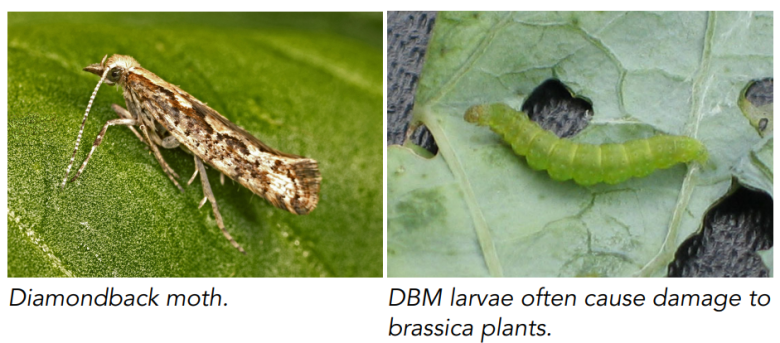
Adult DBM is a small, slender, grey insect with a wingspan of 7-10 mm. When the wings are folded along the body a line of yellow diamond-shaped spots are visible, hence the name.
Adults are nocturnal, and the female lays up to 100 light yellow oval eggs, usually on the underside of leaves.
On hatching, the 2 mm long larvae are pale green with a dark head. Fully grown larvae vary in colour, but are mostly green and 7-9 mm long. They are widest in the middle, and taper slightly towards each end.
DBM pupae are up to 7 mm long and are pale green but change to pale creamy-brown colouring with darker markings. These are enclosed in loosely woven cocoons often found on the underside of leaves in the crop.
Larvae cause damage by feeding on leaves, with young larvae boring into the leaf and feeding on the internal leaf tissue, which appears as white markings on the leaves.
As they grow, they feed on the underside of leaves, with damage appearing as holes in the leaf.
It can be hard to distinguish between DBM larvae and white butterfly caterpillars, with the only major difference being in their behaviour when disturbed.
DBM larvae tend to drop off leaves on a thread when disturbed, while white butterfly caterpillars tend to rear up and be quite aggressive. As DBM tend to drop off the leaves onto the soil surface, care must be taken when inspecting crops to ensure the full extent of infestation is recognised.
Forage crops are usually attacked by DBM through the summer. Damage is more noticeable in autumn when the pest population is high and plants are growing more slowly.
Prevention & management
Many brassica crops can compensate for early damage, and if left untreated DBM can be minimised by natural enemies. Two parasitoid wasps have become established in NZ as active biological control agents.
Monitor crops weekly. Insecticide application can achieve good DBM control.
Greasy cutworm (GC) (Agrotis ipsilon aneituma)
Greasy cutworm (GC) is found in open areas below the snow line throughout NZ. It is sometimes a serious problem in brassicas, chicory, cereals and maize, as well as
pasture at establishment.
Identification
Adult GC are brown to greyish brown moths with darker patches on the forewings and a wingspan of around 50 mm. The peak moth population occurs between October and April, but they can be seen year-round.
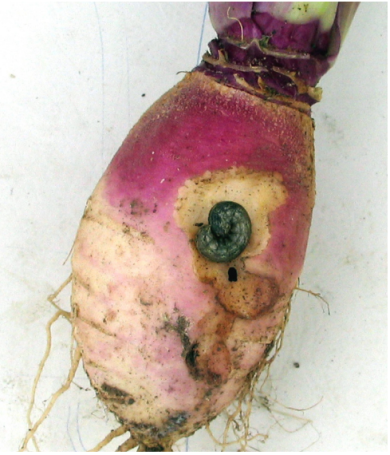
Larvae appear greasy, ranging in colour from light grey to dark brown, and are 50 mm long when fully grown. During the day they lie in burrows just below the soil surface, and emerge at night to feed. This species normally overwinters in the soil as pupae, although some larvae overwinter in warmer areas.
There can be up to three generations per year in warmer areas, but only two in cooler areas, with each lasting for 4-28 weeks depending on climate, locality and feed supply.
GC can severely damage new sowings within a few days, so checking and monitoring paddocks is essential.
Prevention & management
The main period of activity for GC is October to April. Although insecticide can give adequate protection against GC, prevention through good cultivation and good weed control also helps to keep this pest at low levels. Direct drilled crops are most likely to be affected by GC.
A range of insecticides have registration for use against GC. These can be sometimes be used in combination with a pre-emergence herbicide to reduce GC numbers. Granular insecticide sown with the seed or later worked into the top 15 cm of soil can also control this pest.
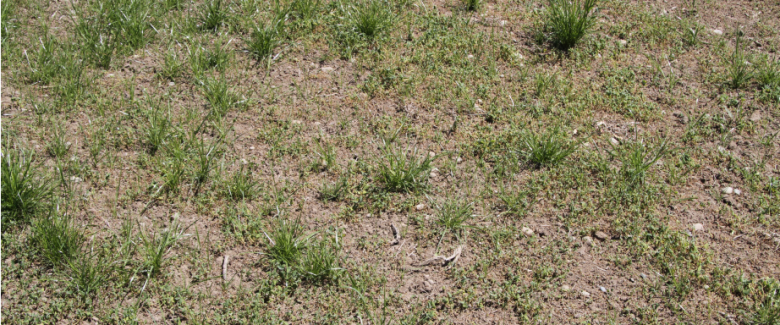
Leaf miners (LM) (Scaptomyza flava)
Leaf miners (LM) are flies found throughout NZ. The larvae live in leaf tissue, in the mines or tunnels they create as they feed. They have a wide range of host plants, including most brassicas.
Identification
Adult LM flies are small, about 2-3 mm long and are usually black with or without yellow areas on the body or the legs.
LM larvae are small, yellowishgreen headless maggots with black rasping mouthparts.
Their eggs are laid on or in leaf tissue and the larvae feed on this after hatching. ‘Mines’ are created according to the feeding habit of the miner, usually by feeding within the leaf, while the two outside layers remain intact. This can result in large windows of damage in the leaf.
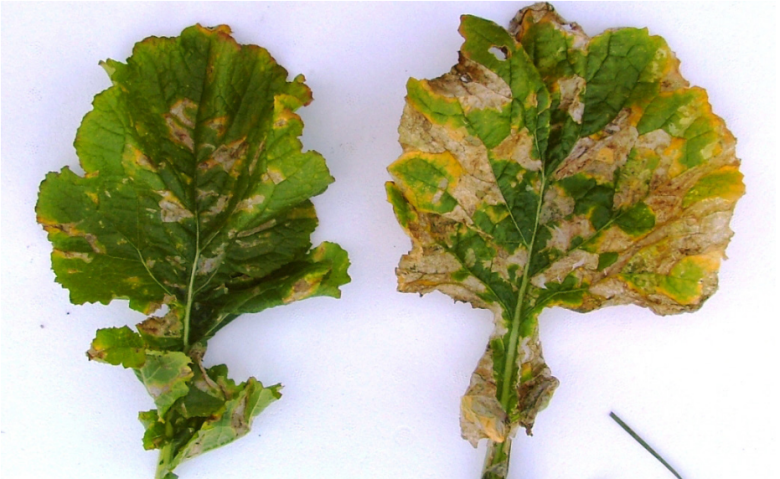
Once they finish feeding, the larvae leave the mines and drop to the soil or leaf litter to pupate.
Mining damage can occur on young seedlings and mature plants. The fly breeds year round unless interrupted by poor conditions. Under dry conditions pupae may remain dormant in soil for up to 300 days.
Plant damage is directly related to the extent of tissue destroyed by mining, reducing photosynthesis, crop development and crop yield. Mining damage can also lead to early leaf senescence and fall, further reducing harvestable yield.
Prevention & management
A number of parasitoids have been developed against LM in NZ, including the wasp Asobara persimilis which has shown significant levels of parasitism in localised populations.
Remove alternative hosts such as fathen and sow thistle to prevent population buildup and minimise damage. Good seed bed cultivation also minimises outbreaks.
Insecticides can be applied to reduce damage by LM. As larvae feed on the inside of leaf tissue, use an insecticide that penetrates the leaf cuticle.
Nysius (Wheat bug)
Nysius huttoni (wheat bug) is found throughout NZ, particularly in the East Coast and Central and North Otago. It damages emerging brassica crops by feeding on the young stems.
Identification
Newly laid eggs are creamy white but turn deep orange by the time of hatching. There are five wingless nymphal stages, with the first around 0.5 mm long and pale to dark orange, while later stages are up to 2 mm long and grey to brown-grey.
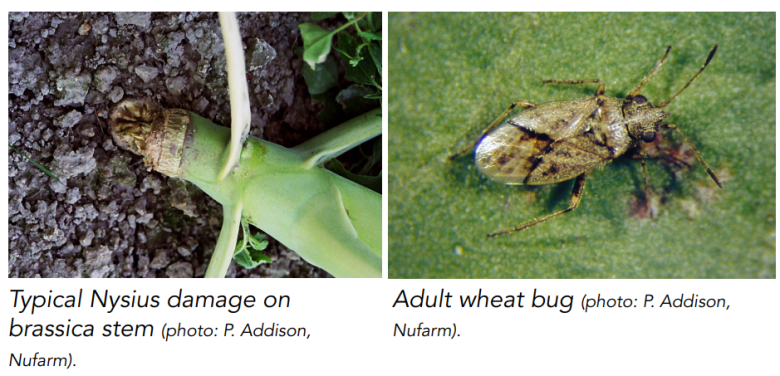
Adults are about 4 mm long and usually pale green initially, but change to a dull brownish grey as time progresses. Adults have a dappled appearance with a conspicuous silvery triangle at the tail end.
There can be up to four generations in a year. During summer the insects are active fliers. This period also coincides with the major period of damage to brassica crops, as they emerge.
Nysius damage brassica crops by puncturing around the base of seedlings, which causes an open wound to form in the tissues. Young seedlings can die quickly, while the damage has a ring-barking effect on older seedlings. The full extent of damage may only be seen at later stages in growth, where the plant may break off at ground level in strong winds.
Prevention & management
Seed treatment, such as Agricote Brassica, offers the best early protection against this pest. If seed has not been treated, an application of insecticide at the final spray out or at early emergence is recommended to avoid large crop losses at this stage.
Springtails (Bourletiella sp.)
There are several species of springtails; the only one that damages brassicas is the garden springtail (Bourletiella hortensis). They are found throughout NZ, with little known about their lifecycle.
Identification
Garden springtails (GS) are soft-bodied, brown to black and up to 1 mm long when fully developed. The bodies are globular and have a springing device which is folded under the body when not in use. Mouthparts are adapted for chewing, and eggs are laid in the soil. Several generations may be produced in a single year.
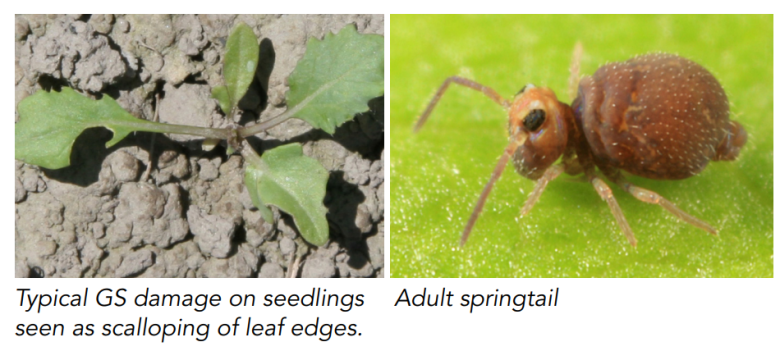
GS are hard to detect with the naked eye against the soil or plant surface, so to test if they are present, use a piece of white card. Place the card on the soil surface and while tapping around it, watch for GS jumping onto the card.
The nymph is similar to the adult in every respect, just smaller.
Damage to brassicas can occur as soon as the plant cotyledons emerge, which can result in stem damage even before they grow above the soil surface. Peak GS populations occur in spring and autumn.
Damage to seedling leaves appears as scalloping of the edges of the leaves or as small pits or shot holes. The latter damage can also be caused by wind blown soil particles as the plants emerge.
Prevention & management
Agricote Brassica seed treatment or application of a suitable insecticide offer the best early protection against this pest.
Early detection is essential. To avoid damage, preventative sprays should be applied at or just prior to crop emergence.
White butterfly (Pieris rapae)
White butterfly (WB) is found throughout NZ. The caterpillar causes damage by feeding on the leaves of brassica crops.
Identification
The adult WB has four broad cream to white wings with black spots and a grey to black body. The female has 2 pairs of black spots on the forewings, while the male has one pair of spots. Their bodies are about 20 mm long with a wingspan around 50 mm.
Females lay 300-400 eggs on the underside of leaves of the host plant. They are laid singly on more than one plant, initially creamy white but changing to orange just before they hatch.
Caterpillars are dull green with small hairs giving a velvety appearance. During the five larval stages, they grow from 2 mm to 30 mm long. In later stages, an orange-yellow stripe can be seen along the back. It can be hard to distinguish between DBM larvae and white butterfly caterpillars. The only major difference is their behaviour when disturbed. DBM larvae tend to drop off leaves on a thread when disturbed, while white butterfly caterpillars tend to rear up and be quite aggressive.
Caterpillars feed on the outer, older leaves of the brassica crop initially, but as they grow move into the centre of the plant. Feeding starts from the leaf margin towards the central leaf vein, with feeding damage mainly occurring from October to May.
WB pupa are around 15 mm long, with a hardened outer shell, and gain protection by hiding where their colour blends in with the background (i.e. in leaf litter or on fence posts or sheds).
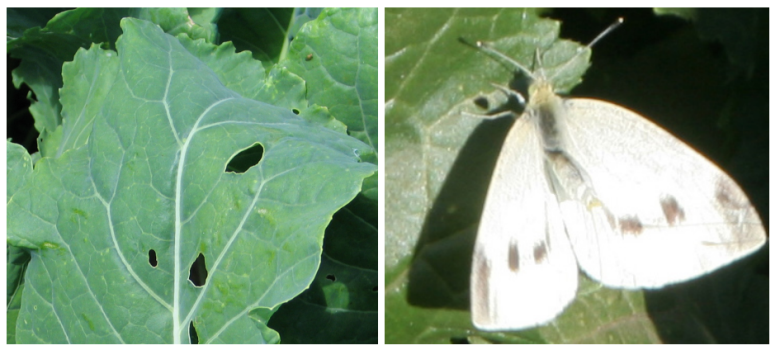
Typical WB damage on kale leaf. Adult WB.
Prevention & management
Natural predators like hoverflies, harvestman and parasitic wasps can keep WB populations in check.
Good seed-bed preparation helps prevent infestation, because the removal of old brassica crop debris prevents over-wintering and localised build up in paddocks.
If damage is apparent insecticides can be effective in the control of WB.
Barenbrug wishes to acknowledge the book ‘New Zealand Pests and Beneficial Insects’ edited by R.R. Scott and Landcare research in producing this section.