
Transformative technology doesn’t succeed on its own!
Remember when cow wearables first came out?
In 2018, DairyNZ estimated just three per cent of Kiwi cows were fitted with some type of tracking technology. In 2023, it was 16 per cent. Today, we’re pushing 25 per cent.
The collar (or bolus or tag) itself isn’t much use. Neither is the data it collects. It’s how farmers use the data that makes the difference.
In other words, the most sophisticated technology advances you not one step unless you capture its potential in real terms.
For us as plant breeders, the analogous question is: How might farmers fully exploit the performance gains of Array ryegrass over the likes of Governor or Nui, and what is the value of doing so?
We’re not financial modellers, so we invested in getting someone better qualified to answer this. The results surprised even us!
Big picture
Much as we’d like to, we can’t get all NZ farms analysed properly in one go. There are just too many variables. Thus we’ve started this project with an upper North Island dairy focus.
Using FARMAX, AgFirst Waikato created a farm model to compare three different ryegrass cultivars across a range of management scenarios. Using Nui, Governor and Array represents old pasture genetics and the best available today.
We’ll dive into details shortly, but the goal was simple: Identify practical dairy farm system changes capable of turning Array’s superior performance into hard dollars and environmental gains.
The outcome is clear. Investing in advanced pasture genetics can return thousands of extra dollars, even after accounting for seed, fertiliser and other costs.
Also of real interest? The modelling shows improved ryegrass can translate directly into both significantly stronger farm profitability, and lower emissions intensity. Both matter - the first to keep your business sustainable, the second to meet global customers’ carbon zero targets.
Keeping it real
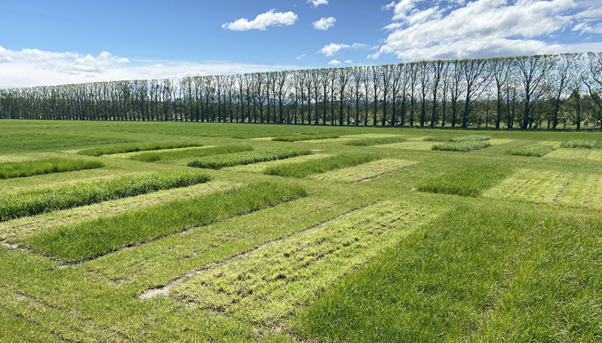
Nui SE is the baseline for this exercise. Governor AR37, launched eight years ago, is the mid-range cultivar, a top option in its day now superseded. Array NEA2 is the high-performing cultivar.
Critically, all three have been trialled over many years, so yield and feed quality data fed into the model are grounded and consistent.
Each cultivar is assessed in the same context - a 136 ha seasonal supply farm, milking 371 cows for average annual milksolids of 145,000 kg.
This hypothetical farm is built on 2025 results from the AgFirst Dairy Financial Survey of 27 farms in Waikato and Bay of Plenty, which in turn typify average farm performance from 4000 farms in the region.
For a fair comparison, each farm model had to start and end the year with the same pasture cover and cow body condition score, regardless of the cultivar used.
Cheap as chips
As every farmer knows, it’s not the amount of grass you grow, but the amount eaten that matters!
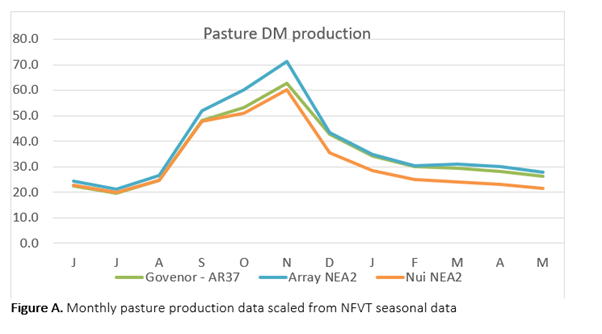
For this analysis, the FARMAX model assumes Governor’s advantage in extra feed eaten is +0.9 tonnes DM/ha over Nui, while Array’s is +1.7 t DM/ha. These figures are evidence-based, and to be conservative scaled back to 80 per cent of actual differences measured in field trials.
Testing has also shown Array produces higher quality feed than Governor, with a gain of about 0.3 MJ ME/kg DM in last spring and summer. In FARMAX, this translates to cows producing +15 kg milksolids per head during this time.
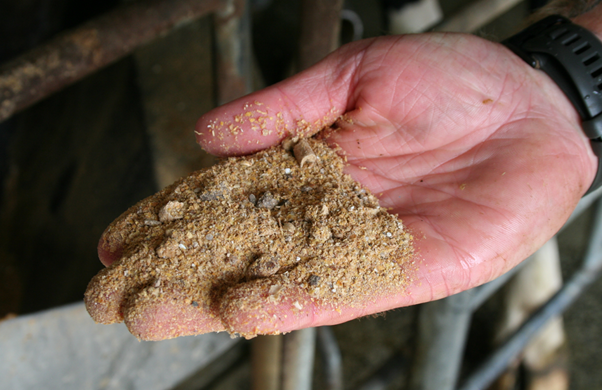
The big result from the modelling, in terms of feed cost? It costs just over 1 cent per kg DM to grow extra pasture with Governor and Array, far cheaper than purchased feed (about 40 c/kg DM) or nitrogen-boosted feed (about 16 c/kg DM).
This again reinforces the core principle of NZ pastoral farming – no feed is more cost effective than the grass you grow at home.
But unless you put this grass to effective use, it’s a bit like getting heaps of data from a cow collar and not doing anything with it. We wanted actionable outcomes from this analysis, so different system changes were evaluated.
Cut to the chase
The model compared using the extra growth from Governor and Array to feed less supplement; milk longer, or lift farm stocking rate.
The sweet spot was found to be keeping cow numbers and calving unchanged; feeding more pasture and much less supplement, then feeding out 20% of the saved supplement in May to extend lactation and improve MS production.
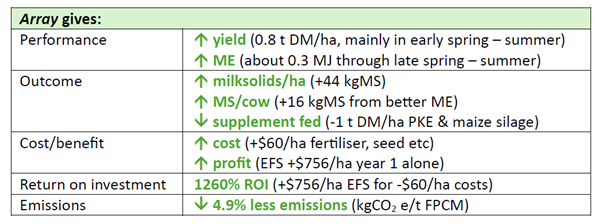
In this case, Governor increases Economic Farm Surplus (EFS) by $510 per hectare and Array increases EFS by a further $756 per hectare over Governor in just the first year.
These returns are after allowing for the extra seed, fertiliser and dairy costs required.
For Governor, the return on investment in seed is 253%. Array delivers a 478% return.
Outcome – Array vs Governor
How much?
We are happy to confess the returns FARMAX calculated are much bigger than we expected! They show the significant profit high performance cultivars can deliver, when their extra growth is converted into milk coupled with reducing imported feeds.
The modelling also shows lower emissions intensity (kg CO₂e per kg MS) for Array, and lower purchased nitrogen surplus for both Governor and Array when supplement use is reduced.
We asked Fonterra to put the modelling through its emissions intensity calculator, and the results were an estimated 4.4 per cent and 8.8 per cent reduction from Governor and Array respectively, compared to the results a farm would see in Farm Insights reports.
Both the FARMAX model and Fonterra’s calculator support the large industry study last year, which showed home grown feed drives both improved profitability and emissions intensity.
Take-home truth
The FARMAX results reveal the scale of the opportunity for farmers who adapt their system to exploit feed benefits of improved pasture cultivars.
The challenge we now put to you is to grab the opportunity for yourself. The better your pasture renewal programme and pasture utilisation, the bigger the gains.
And remember we’re always available to help anyone who wants to improve these. Just book your free Pasture Health Check today.
Book a free pasture health check
Click here to request a free on farm pasture health check with one of our local experts.