
Go the distance
Inside the search for staying power
In the early 1990s, the cutting edge of climate-adaptive pasture in New Zealand was a combination of fescue, cocksfoot and phalaris.
Triple mix, backed by advisors of the day, left a mark, but not the one its supporters intended.
It grew in tough conditions, for sure. Too well, in many cases! Management was difficult and decades later, it is rarely recalled with affection.
But the challenge it tried to answer has not gone away. If anything, productive pasture that can weather erratic, sometimes extreme elements, year after year, has only become more valuable.
What might we learn from those who have faced this reality longer than most?
When 'weed' becomes 'grass'
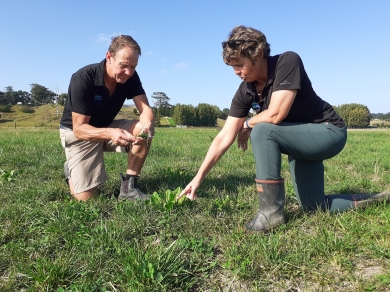
Twenty years ago no-one outside Northland rang Kim Robinson for pasture advice. Now the experienced AgFirst farm consultant and Northland Dairy Development Trust co-ordinator regularly hears from farmers much further afield.
What happened?
“Kikuyu moved south,” she says. “As it marches down the North Island, more and more farmers are being exposed to it, and they don’t know what to do. Outside Northland, it’s still seen as a weed.”
When a plant you have been trained to eliminate from the sward becomes the only thing still standing after a flood or a drought, the question changes.
Not ‘how do I get rid of it?’ but ‘how can I work with it?’
Love the one you're with
Accepting this subtropical grass has been a gamechanger for some Northland farmers whose ryegrass was barely lasting five years before succumbing to heat, moisture stress, insect attack and kikuyu regression.
Trials on the Northland Agricultural Research Farm 10 years ago proved kikuyu could be dairy farmed as profitably as perennial ryegrass if managed a certain way.
Italian ryegrass is part of the recipe. It grows when kikuyu is quiet, and supports a year-round grazing system the Trust has repeatedly validated, with seed provided by Barenbrug.
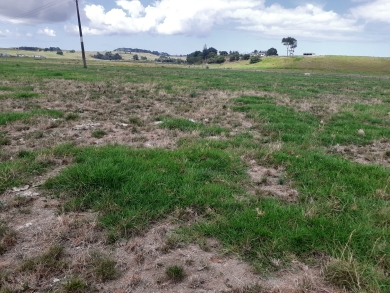
Kim says after Cyclone Gabrielle, the research farm sat underwater for four days. Clover, chicory, fescue, cocksfoot, ryegrass and plantain died. Kikuyu did not.
Tightly controlled before winter, it can withstand frost, and the Trust has just started trialling a modern kikuyu cultivar from Australia to look for more gains.
“Our endemic kikuyu is the equivalent of ryegrass before Nui, and we’ve got farmers doing well with it. Imagine how they might go with one that has been bred for improvement…”
Trial, error and the next 10%
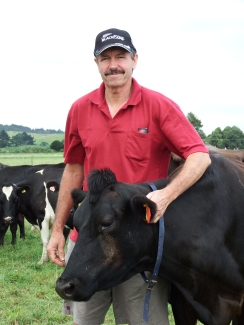
Kerry Chestnut and sons Ryan and Nathan didn’t start experimenting with fescue six years ago because their Northland perennial ryegrass-based dairy pastures were unproductive.
Consistently growing more than 13 tonnes of dry matter a hectare, “we were just looking for the next 10%,” he says. “We wanted a bit more persistence, and something that could compete with the kikuyu.”
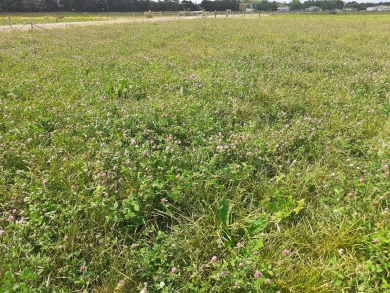
Up to a third of pasture on the family’s two 110 ha milking platforms is now fescue mixed with tetraploid or diploid ryegrass, plus clover.
Orthodoxy says do not mix ryegrass with fescue because the growth patterns clash.
In this system, Kerry says the clash is about four weeks, mid-September to mid-October, when they head. The rest of the year they’re compatible.
Writing their own rules
The usual advice is to graze new fescue hard and short. But the Chestnuts have kept the rotation in the first two years much the same as their ryegrass paddocks.
A short rotation too early, they’ve found, is hard on the crown, and the crown is what must get through a dry summer on heavy clay, after a winter when the same soils can pug.
Likewise, the first grazing is later than straight ryegrass pastures by about a fortnight. Not because fescue is slow, but because they want a strong root system for longevity. Clover, in those paddocks, rarely suffers from the delay.
“There is still a huge amount to learn with fescue,” Kerry says. “Research is in its infancy. The variation between cultivars is massive compared with ryegrass. And the management can’t be compared with it either.
“A lot of fescues haven’t even been looked at here because of low winter growth, but that’s in Northern Hemisphere winters, not Northland.”
A problem shared is a problem halved
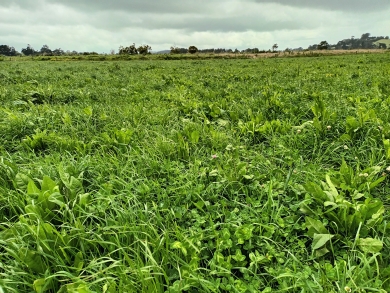
As other regions begin to experience challenges facing her farmers, including declining pasture yield, a wider range of insect pests, and extremes of wet and dry, Kim Robinson says access to – and management support for – viable alternative pasture species is essential.
Northland’s gone it alone until recently, because it had to. Now the industry is funding more research through the likes of the six-year Resilient Pastures programme, however, both she and Kerry Chestnut hope for faster progress.
As a long-time supporter of the Northland Agricultural Research Farm, and a partner in Resilient Pastures, we too look forward to outcomes of this work.
But we know regional pasture challenges aren’t limited to just one part of the country. If you’re looking for answers to your own pasture questions, no matter where you farm, just reach out today. We’re here to help.
Just get in touch with us for a free, personal Pasture Health Check to start making your own improvements straight away.

Book a free pasture health check
Click here to request a free on farm pasture health check with one of our local experts.