
4front
Top tetraploid ryegrass with unbeaten yield, better persistence, easy grazing & lower enviro impact.
-
Best of the best
-
Unbeaten in National Forage Variety Trials
-
Superior year-round growth
-
Enhanced persistence
Perennial ryegrass
NZ's top selling tetraploid perennial, with superior year-round growth, enhanced persistence, easy grazing and excellent animal performance. It’s better for the environment, too.
Best of the best
4front grows more feed than any tetraploid perennial we’ve bred. Equally important? It achieves this in both cool and warm conditions.
Unbeaten in NFVTs
In the 2025-26 National Forage Variety Trials (NFVT) results, no other tetraploid perennial grew more total yield across all New Zealand trials.
More tillers
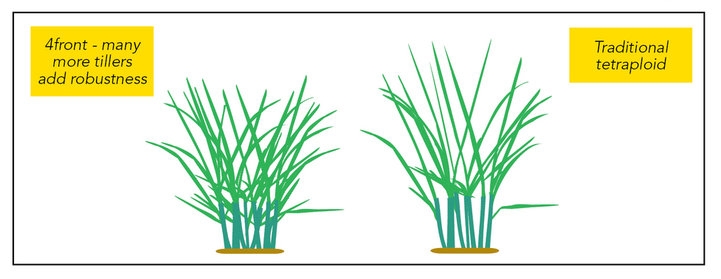
The more tillers in a pasture, the more robust it is. Each tiller is an individual which can be killed by many pressures, including drought, pugging, insects and overgrazing. 4front’s enhanced tillering helps it persist when conditions are tough.
Piece of cake!
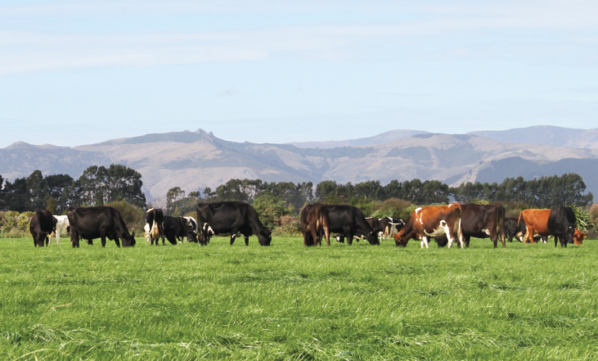
Animals love tetraploids. That simplifies grazing management. Soft, high quality, legume-friendly tetraploid pasture makes life easier for your animals, too. Every bite takes less effort, encouraging animals to eat more for higher daily intakes. The result? More milk in the vat, and faster LWG for finishing stock.
Grazing is hard work! A cow on pasture might take 25,000 bites every day; a ewe, 40,000. 4front’s soft leaves make a big difference to their quality of life.
Lose less N & GHG
With higher animal intakes and easier management, 4front can help lighten your farm footprint. Tetraploid ryegrass-based pastures, or tetraploid/diploid mixes, allow farm system changes to reduce nitrogen leaching while improving pasture growth and animal intakes. This is the future of NZ farming.
A dramatic example of this is the Lincoln University Dairy Farm (LUDF). It has cut N leaching by 40% and greenhouse gases (GHG) by about 22%, through a range of system changes including:
- Capturing more photosynthesis – pre-grazing covers are 300 kg DM/ha higher with tetraploids, growing an extra 1.2 t DM/ha/year across the whole farm.
- Longer grazing round (average +4 days) meaning fewer grazings per paddock and 30% better nitrogen use efficiency.
- Higher cow production (+26 kg MS/cow) from fewer cows and better pasture intakes.
- Applying 170 kg/ha/year less N fertiliser.
LUDF couldn't have achieved this without sowing tetraploid ryegrass in every paddock but one.
Mixing 4front & Maxsyn or Array
4front can be sown alone on many farms, but when you mix it with Maxsyn or Array diploid perennial ryegrass, its benefits can be extended to a wider range of farm systems.
Some farmers struggle to avoid over grazing straight tetraploids, and don’t get the persistence they want. Adding a denser, finer diploid ryegrass to the mix makes it more robust. Diploid plants protect the tetraploid (see Mixing tetraploid & diploid ryegrass)
Very low chance of staggers
For dairy cows and beef cattle, 4front provides ryegrass staggers free pasture.
For sheep and deer, ryegrass staggers grazing NEA2 endophyte is a very low risk. In extreme situations, such as drought where animals are forced to graze close to the ground, a low level of staggers might very occasionally be seen.
Sowing 4front
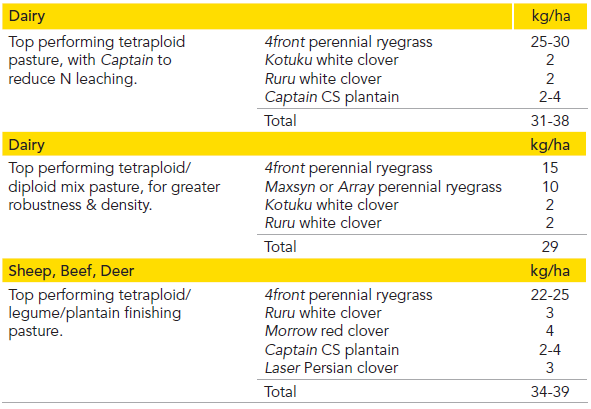
Download more information here:

4front